Independent Report on The CPP Framework Document Alleged Alterations by Alaco Limited and Omnia Strategy LLP
“The Framework of Political Persecution: The Case of Alexander B. Cummings”
24 My 2022
PROJECT LINCOLN
Prepared by Alaco Limited and Omnia Strategy LLP
Contents
FOREWORD BY CHERIE BLAIR………………………….. 3
I. EXECUTIVE SUMMARY………………….. 5
II. INVESTIGATIVE TEAM………………………….. 9
III. CAST OF CHARACTERS…………… 10
IV. INVENTORY OF DOCUMENTS REVIEWED……………….. 12
VI. EVOLUTION OF THE FRAMEWORK DOCUMENT………………. 17
VII. REVIEW AND ANALYSIS OF THE CPP INVESTIGATIVE COMMITTEE REPORT. 19
Objectives and composition of the CPP Investigative Committee………………………………. 19
Additional content differences not identified by the CPP Investigative Committee……………….. 34
VIII. REVIEW AND ANALYSIS OF THE CONTENTS OF THE CPP WHATSAPP ………………….
Absence of the messages sharing files with the NAC Chatroom………………… 36
Absence of numerous messages sent to the NAC Chatroom in July 2020 38
Reason for the absence of the messages in Exhibit P/6………………………….. 39
Failings and improper findings of the CPP Investigative Committee Report…………………….. 41
Omissions in the WhatsApp evidence produced in support of the Prosecution’s case in the
Liberian Criminal Proceedings…………….. 43
This independent report has been prepared by Alaco Limited and Omnia Strategy LLP. The information it contains has been obtained in good faith from open sources and individuals deemed reliable by us. Neither Alaco Limited nor Omnia Strategy LLP, nor the respective employees and/or agents of the same, accept legal responsibility for any inaccuracy, omission or opinion this report contains.
FOREWORD BY CHERIE BLAIR
Political discourse can be lively and robust, creative and sometimes uncompromising. Democracy thrives and communities benefit when arguments are met with reasoned counter-claims, character and rhetoric are tested and candidates’ fitness for office is scrutinised. But politics cannot be a free-for-all with honesty and probity abandoned for the sake of gaining or maintaining power. Our paramount guardrail is the Rule of Law, which in turn demands truth and integrity from those who are in – and who are seeking – public office.
This Report is the result of an investigation commissioned to look into the ostensibly serious allegations of forgery levelled at Alexander Cummings, political leader of the ANC. Mr Cummings is accused of tampering with the ‘Framework Document’ that brought to life the CPP, a historic unification of four political parties opposing the Weah Government and the ruling CDC party. These allegations were upheld by the CPP’s own internal review and then formed the basis of a prosecution before Liberia’s criminal courts. Mr Cummings’ integrity has been put under the microscope, but so too have the conduct and claims of his erstwhile CPP partners and the Government officials enthusiastically prosecuting this case. The stakes are high, with a presidential election around the corner in 2023. Democracy and decency require – and the people of Liberia deserve – for the truth to be established.
The “Rule of Law” is at the heart of this case and with it the fair exercise of power by government, the right to a fair trial, the application of law rather than arbitrary whim, and the protection of fundamental human rights. In the cut-and-thrust of party politics, the Rule of Law should enable debate but constrain leaders from resorting to misinformation, abuse of process and other dirty tricks. It is not only good in itself, because it embodies and encourages a just society, but is also a cause of other good things, including growth and a cohesive society bound together by trust in our electoral system and elected representatives. This cohesion must be constantly nurtured, and this trust continually earned. Unfortunately, we see both under threat and in varying states of disrepair in many corners of the world.
Liberians know about the Rule of Law and have grappled with what this should mean for their country in practice, from pursuing justice for atrocity crimes to rooting out corruption in public office. Now Liberians and their friends internationally must examine whether the Rule of Law is being ignored – or even intentionally flouted – to arrest the progress of a prominent political opponent to the Weah Government.
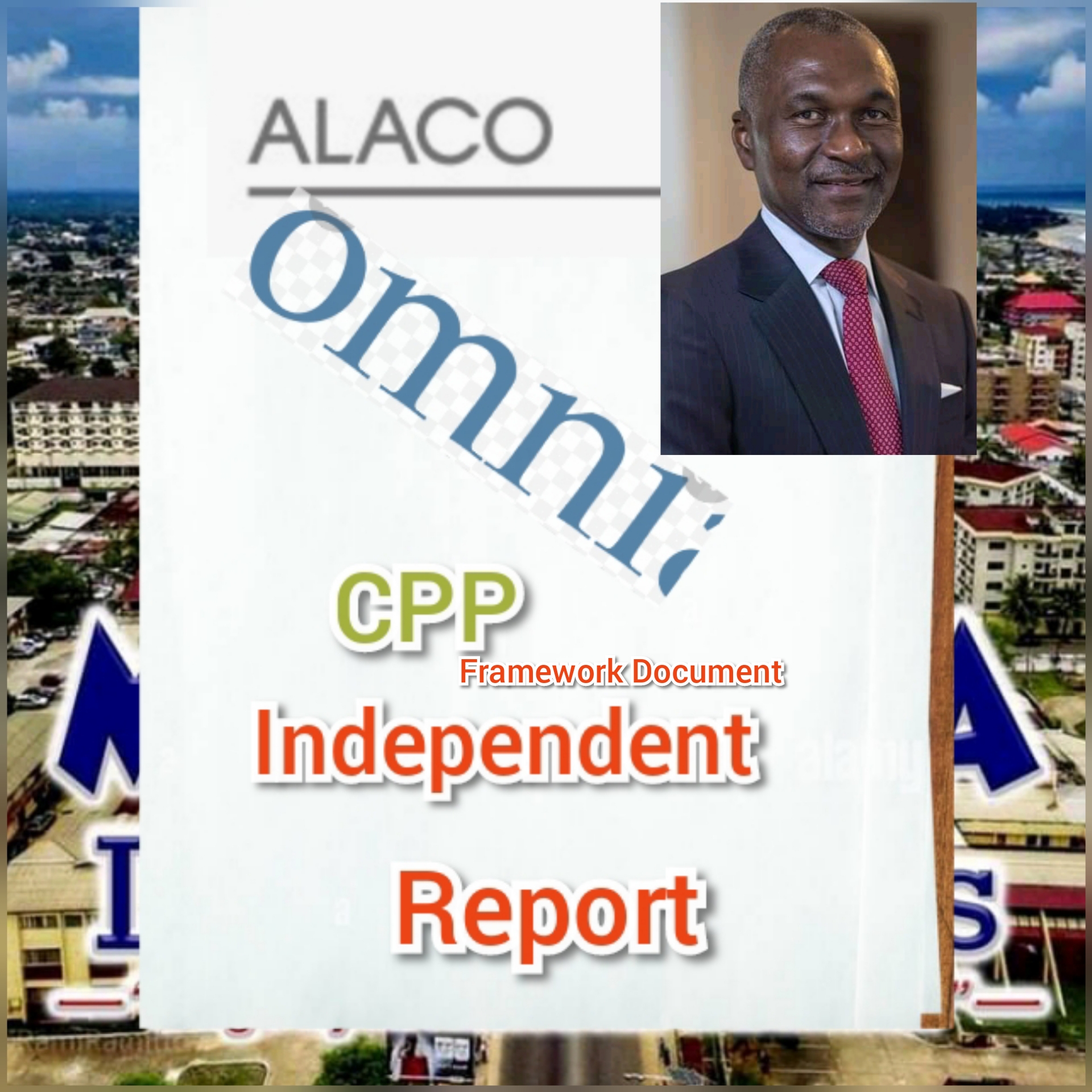
The creation of the CPP was a rare attempt to unify an often fractious political field in more effective opposition to the ruling CDC party. As leader of the ANC and a central figure in the formation of the CPP, Alexander Cummings is a prominent challenger to the Weah Government. Just as we should expect the highest standards from Mr Cummings, we must be wary of allegations and criminal charges that would conveniently neutralise the political threat he represents. History warns us that incumbent governments can sometimes give in to the temptation to load the deck against upstart challengers, and state institutions can end up facilitating such abuse of office, like a football match referee playing as one team’s twelfth man.
Our independent investigation of the allegations against Alexander Cummings has been thorough and forensic, our Report is dispassionate but compelling, and our conclusions are clear. The old adage that there is “no smoke without fire” does not apply here. To the contrary, this Report lays bare how baseless complaints have been upheld and bolstered by a fundamentally unreliable, amateurish, political process masquerading as a neutral investigative review, and are inexplicably now before the criminal courts. Whether this was simply incompetence or something more underhand remains to be seen, but four things appear certain:
- The integrity of Mr Cummings has been impugned without any legitimate basis;
- The internal CPP Investigative Committee Report is wholly unreliable, and a shoddy and unsafe basis for any public investigation let alone a criminal prosecution of a prominent political opponent led by the Solicitor General for the Weah Government;
- Those standing to benefit from these spurious attacks on Mr Cummings are his political opponents, both in the Executive Mansion and others vying for presidential office in 2023; and
- Given the woefulness of the case against Mr Cummings and his fellow ANC member codefendants and the substantial effects this would inevitably have on their political aspirations and Liberians’ choice in next year’s election, questions naturally arise concerning the motivation of his accusers and those pushing criminal prosecution.
This Report is rightly critical of the CPP’s own Investigative Committee’s review and findings, and personally I find it surprising and disappointing that Liberia’s Prosecution Authority would consider bringing such a weak case to court. However, our task has not been to second-guess the ongoing work of Liberia’s courts. My sincere hope and expectation is that the judiciary, as primary guardians of the Rule of Law, will see that justice is done. Liberians deserve nothing less.
I. EXECUTIVE SUMMARY
- On 23 February 2022, Alaco Limited and Omnia Strategy LLP (“Alaco” and “Omnia” and, collectively, “we”) were instructed by Mr Cummings, Political Leader of the Alternative National Congress (“ANC”) in Liberia, to undertake an independent review of allegations made by the All Liberian Party (“ALP”), through its political leader Mr Urey, against Mr Cummings and two other senior figures in the ANC, Mr Naatehn and Mr Toe.[1] These claims stem from an internal dispute within the Collaborating Political Parties (“CPP”), an alliance formed by four political parties in Liberia: the ANC, the ALP, the Liberty Party (“LP”) and the Unity Party (“UP”) (collectively referred to as the “Constituent Parties”). The ALP’s core allegation is that Mr Cummings conspired with Messrs Naatehn and Toe to tamper with the CPP Framework Document prior to it being filed with the National Elections Commission of Liberia (“NEC”).[2] The ALP’s allegations formed the basis of the presently ongoing criminal trial in Monrovia, in which Mr Cummings and his co-defendants are accused of forgery and criminal conspiracy (the “Liberian Criminal Proceedings”).[3] Mr Cummings denies the allegations.
- We have been tasked with conducting a thorough and independent investigation of the facts surrounding these allegations and to report our findings (the “Report”). Specifically, we have: (i) analysed the evolution of the Framework Document through its various drafts and iterations; (ii) scrutinised the communications by and among the Constituent Parties during the process of negotiating, finalising and registering the Framework Document; (iii) reviewed and tested the findings of the CPP Investigative Committee established by the Political Leaders of the Constituent Parties to examine the allegations;[4] and (iv) forensically compared various WhatsApp chatroom logs and those submitted by the Prosecution in the ongoing Liberian Criminal Proceedings to identify and assess any discrepancies.
- Our analysis and findings are set out in detail in this Report but, in summary, our primary observations are:
- The CPP Investigative Committee Report is fundamentally flawed, both in terms of its process and its stated conclusions. It does not withstand scrutiny, provides no reliable substantiation for the allegations and is a wholly unsafe basis for any criminal prosecution. Given the inevitably serious personal and political implications of the CPP Investigative Committee Report’s findings – particularly the potential to stigmatise Mr Cummings and undermine his standing as a front-running candidate for the Presidency – democracy required and Liberians deserved a rigorous investigation, dependable analysis and sound conclusions. Instead, the manner in which the allegations have been casually amplified and wrongly given credence raises important questions about the motivations of the CPP Investigative Committee and the enthusiasm with which its findings have been used by the Government of Liberia to underpin the criminal prosecution of a political opponent.
- The existence of substantial differences (of structure and content) between the Original FD – whether dated 25 April 2020 or 19 May 2020 (see paragraph 12 below) – and later versions of the Framework Document is not in dispute but nor is it untoward. Such an evolution is the logical and expected consequence of the iterative process of negotiating the Framework
Document. In particular, the introduction of the Legal Advisors’ proposed amendments to the Original FD,[5] which were then incorporated into the Post-Review FD, were reviewed and approved by the Constituent Parties prior to registration of the Framework Document with the NEC.
- Whether deliberately or unintentionally, the CPP Investigative Committee did not take into account key events relating to the Constituent Parties’ review and approval of the Post-Review FD (between 25 June and 14 July 2020). This failure significantly undermines the findings and credibility of the CPP Investigative Committee Report while the omission of these events from the CPP Investigative Committee’s analysis is inexplicable. In particular, because the circumstances of these events were within the direct knowledge of the CPP Investigative Committee by virtue of the involvement of a number of its members in the very events under review, including the Chairman of the CPP Investigative Committee, Mr Momo. Not only does this glaring oversight raise questions regarding the competence and motivations of the CPP Investigative Committee but, more importantly, the CPP Investigative Committee Report is shown to be flawed and unreliable.
- The central allegation, set out in the CPP Investigative Committee Report, that the signature sheet from the Original FD was lifted and affixed to the NEC-Filed FD, is confounded by the fact that:
- There was no single signature sheet emanating from the 19 May 2020 virtual signing bearing all of the required signatures of the Party Leaders and Chairpersons of the Constituent Parties; and
- There are structural and formatting inconsistencies between the signature sheet used during the 19 May 2020 virtual signing and the fully-executed signature sheet that was filed with the NEC on 14 July 2020 (see Exhibit H, as reproduced here):
- With respect to the ALP specifically, our investigation has determined that the party’s Chair, Mr Momo:
- Confirmed receipt of the Post-Review FD in the NAC Chatroom[6] on 27 June 2020;
- Confirmed that the ALP was “working hard” at preparing the party’s resolution to adopt the Post-Review FD on 29 June 2020;
- Commented during the 1 July 2020 Zoom meeting that he saw “nothing major” with the Legal Advisors’ edits to the Framework Document as reflected in the Post-Review FD; and
- Signed, alongside Mr Urey, the ALP’s resolution approving and adopting the Framework Document on 7 July 2020, after the Post-Review FD was in circulation. In
our opinion, it is implausible that the ALP had contemplated an earlier version of the Framework Document when signing its resolution endorsing the creation of the CPP.
- Our comparative analysis of the Authenticated NAC Chatroom Export (which we obtained during the course of our investigation) and Court Exhibit P/6 (which was filed by the Prosecution in the Liberian Criminal Proceedings) reveals a number of glaring omissions in the
Prosecution’s WhatsApp evidence.[7] These omissions include:
- Messages sent in the NAC Chatroom between 2-19 July 2020 in which Mr Cummings circulated the Final FD, which was acknowledged by other members of the chatroom, including Mr Momo of the ALP, who were kept informed about the progress of the submission process of the Framework Document; and
- All messages in which files were sent to the NAC Chatroom, including versions of the Framework Document provided to the Constituent Parties for their review.
- The Prosecution has acknowledged that messages sent into the NAC Chatroom were missing from Court Exhibit P/6, stating that these omissions were inadvertent. However, in our opinion, it strains credibility that these omissions resulted from several pages of the Prosecution’s exhibit having been inadvertently misplaced. Rather, there is a pattern of exculpatory evidence having been selectively withheld by the Prosecution.
- In light of our investigation, we have serious concerns regarding the findings of the CPP Investigative Committee Report, which was lacking in each of its scope of review, analytical rigour and conclusions. Accordingly, its process and outcome are fundamentally unreliable. Together with omissions in Prosecution evidence, this calls into question, therefore, the very basis upon which the Prosecution has commenced criminal proceedings against Mr Cummings and his co-defendants. Indeed, informed by the findings in this Report – including that it is plainly evident that the Constituent Parties discussed, agreed and approved the version of the Framework Document that was ultimately filed with the NEC – it is difficult to conceive how the allegation that Mr Cummings and others conspired to tamper with the Framework Document could be thought to have any legitimate foundation at all let alone provide safe grounds for prosecution.
II. INVESTIGATIVE TEAM
Omnia Strategy LLP
Omnia is an international law firm founded in 2011 by Cherie Blair CBE, QC. Omnia specialises in bespoke dispute resolution and dispute prevention around the world, through its unique Law+ approach, combining legal expertise with experience across policy, business and communications. Omnia is trusted by government, corporate and private clients to provide legal and strategic counsel on a broad spectrum of matters, including international arbitration, business and human rights, public international law and more unconventional problem-solving.
Alaco Limited
Established in 2002, Alaco is a leading business intelligence and investigations firm, based in London and operating globally on behalf of its clients on both transactional and contentious matters. In support of its clients, Alaco’s multilingual staff draws on its experience from a variety of backgrounds, such as law, government, journalism, financial services, and diplomacy.
III. CAST OF CHARACTERS
- Political Leaders of the CPP Constituent Parties:
- Alexander B. Cummings Jr. (“Mr Cummings”): Political Leader of the ANC
- Benoni Wilfred Urey (“Mr Urey”): Political Leader of the ALP
- Senator Nyonblee Karnga-Lawrence (“Ms Karnga-Lawrence”): Former Political Leader of the LP
- Ambassador Joseph Nyumah Boakai (“Mr Boakai”): Political Leader of the UP
- National Chairs of the CPP:
- Senator Daniel F. Naatehn (“Mr Naatehn”): National Chairman of the ANC
- J. S. B. Theodore Momo (“Mr Momo”): National Chairman of the ALP and Member of the
CPP Investigative Committee
- Senator Steve A. Zargo (“Mr Zargo”): Former National Chairman of the LP
- Musa Hassan Bility (“Mr Bility”): Current National Chairman of the LP (since January 2021)
- Isaac Mannah: Former National Chairman of the UP
- Amin Modad (“Mr. Modad”) Current National Chairman of the UP
- Members of the CPP Investigative Committee:
- Mr Momo: ALP Member and Chairperson of the CPP Investigative Committee
- Augustine Fredericks (“Mr Fredericks”): LP Member of the CPP Investigative Committee
- Cole Bangalu (“Mr Bangalu”): UP Member of the CPP Investigative Committee
- Mohammed Ali (“Mr Ali”): UP Member and Secretary of the CPP Investigative Committee
- Cllr Yafar Baikpeh (“Mr Baikpeh”): ANC Nominee for the CPP Investigative Committee (did not co-sign the final report)
8. Members of the CPP National Advisory Council
UP:
- Mr Boakai
- Mr Modad
- Hon. Hassan Kiazolu
- Cllr Gloria Musa Scot
- Dargah Varblah
LP:
- Ms Karnga-Lawrence
- Senator Abraham Darius Dillon (“Mr Dillon”): Former Vice Chair for Political Affairs and
Sitting Senator of the LP
- Mr Zargo
- Mr Bility
ANC
- Mr Cummings
- Mr Naathen
- Representative Larry Younquoi (“Mr Younquoi”):
- Victoria Torlo Koiquah (“Ms Koiquah”):
ALP
- Mr Urey
- Mr Momo
- Joseph Papa Kolleh (“Mr Kolleh”): Sitting Representative of the ALP
- Telia Urey
- Legal Advisors:
- Cllr Benedict F. Sannoh: Chairman
- Atty Samuel Kofi Woods: Member
- Cllr Philip Karnga: Member
- Justice Kabinah Ja’neh: Member
- Atty Sagie Kamara: Secretary
- Mr Baikpeh: Resource Person (did not participate in decision-making)
- Atty Lafayette Gould: Resource Person (did not participate in decision-making)
(collectively, the “Legal Advisors”)
- Members of the CPP Secretariat during Mr. Cummings Leadership of the CPP:
ANC
- Aloysius Toe (“Mr Toe”) – Head of the CPP Secretariat
- Mulbah Kesselly
LP
- Jacob Smith
- Mr Fredericks
- Kla Toomey
ALP
- Mr Kolleh
- Acarious Tehmo
- Quamilie George
UP
- Patrick Worzie
- Helena Doe Knuckles
- Roland Lafayette Giddings
IV. INVENTORY OF DOCUMENTS REVIEWED
- In the course of our investigation we have independently reviewed and assessed the following:
- The CPP Investigative Committee Report issued on 5 October 2021 by the CPP Investigative Committee (attached, minus its appendices, as Exhibit A);
- Four drafts of the Framework Document,[8] namely:
- The version used by the CPP during the publicised Zoom meeting held on 19 May 2020, titled “Collaborative Framework Document Four Collaborating Political Parties” and bearing the date 19 May 2020 (see paragraph 12 below) (the“Original
FD”, attached as Exhibit B); ii. The version resulting from the legal review of the Original FD, titled “Amended Collaborative Framework Document Of the Four Collaborating Political Parties” and bearing the date 25 April 2020 (the “Post-Review FD”, attached as Exhibit C);
- The version that Mr Cummings shared via WhatsApp with the CPP’s National Advisory Council on 9 July 2020, titled “Collaborative Framework Document Of the Collaborating Political Parties” and bearing the date 19 May 2020 (the “Final FD”, attached as Exhibit D); and
- The version that was filed with the National Elections Commission on 14 July 2020, titled “Collaborative Framework Document Of the Collaborating Political Parties” and bearing the date 19 May 2020 (the “NEC-Filed FD”, attached as Exhibit E);
For the avoidance of doubt, references in this report to the “Framework Document” should be understood as referring to the document generally and not to any specific version in particular;
- Communications and exchanges between the CPP and members thereof, including:
- Notes sent by the Legal Advisors covering the issues addressed or to be addressed following their review of the Framework Document, titled “Issues arising during review of the CPP Document” (the “Legal Notes”, attached as Exhibit F);
- The contents of a WhatsApp chatroom titled “AOL”, created by Mr Urey and featuring, among others, the Political Leaders of the Constituent Parties (the “AOL WhatsApp Chatroom”). The contents of the AOL WhatsApp Chatroom were obtained from an authenticated and exported copy extracted from the cell phone of Mr Cummings;
- The contents of a WhatsApp chatroom titled “CPP Nat’l Adv Council”, created by Mr Cummings and featuring, among others, the Political Leaders, Heads of Legislative Caucuses, National Chairs and Women Representatives of the Constituent Parties (the “NAC Chatroom”). The contents of the NAC Chatroom were obtained from an authenticated and exported copy extracted from the cell phone of Mr Cummings (the
“Authenticated NAC Chatroom Export”); iv. The contents of a WhatsApp Chatroom titled “CPP Legal Advisors”, created by Mr Cummings and featuring, among others, the team of legal advisors drafted to conduct a review of the Framework Document and the Political Leaders of the Constituent Parties (the “Legal Advisors Chatroom”). The contents of the Legal Advisors Chatroom were obtained from an authenticated and exported copy extracted from the cell phone of Mr Cummings;
- A recording of the 19 May 2020 Zoom meeting in which the Framework Document
was first presented to the public; and
- A recording of the 1 July 2020 Zoom meeting in which, among other topics covered, the Constituent Parties provided feedback on the version of the Framework Document most recently shared with them by Mr Cummings (the Post-Review FD);
- The Resolutions of the National Executive Committee of the ALP (the “ALP Resolution”), the
National Advisory Council and the National Executive Committee of the LP (the “LP Resolution”), and the Executive Committee of the UP (the “UP Resolution”) approving the Framework Document, all attached as Exhibit N;
- The Writ of Arrest issued by the Monrovia City Court on 3 January 2022 against Mr Cummings and the co-defendants for forgery and criminal conspiracy, attached as Exhibit R;
- Documents filed in Monrovia City Court in Monrovia, Liberia, during the Liberian Criminal Proceedings, including (but not limited to) the following:
- A copy of the AOL WhatsApp Chatroom provided to the Prosecution by the ALP and which was filed as Court Exhibit P/13; and
- A copy of the NAC WhatsApp Chatroom provided to the Prosecution by the ALP and which was filed as Court Exhibit P/6.
- Two copies of the Framework Document were circulating in parallel on or around 19 May 2020; one bearing the date 25 April 2020 (the date on which the validation committee of the CPP concluded its review of the Framework Document) and the other bearing the date 19 May 2020 (the date of the Zoom virtual signing ceremony). The fact that there were two copies of the Framework Document circulating in parallel at the time was acknowledged in the AOL WhatsApp Chatroom: on 19 May 2020, shortly before the Zoom meeting began, Mr Cummings sent two messages to this chatroom stating: “I’m being told that all of us do not have the same and correct version of the agreement?”; and “By this message I’m alerting all of us that we will need to reconcile versions in addition to the legal corrections”. Our review has confirmed that these two copies of the Framework Document are identical in content, save for the aforementioned difference as to the dates set out on their respective cover pages and a limited number of inconsequential formatting edits. For the avoidance of doubt, our use of the term “Original FD” should be taken as a reference to this document, whether dated 25 April 2020 or 19 May 2020.
- For completeness, we further note that the date and formatting of the cover of the Post-Review FD suggest that the legal review of the Framework Document was conducted on the basis of the Original FD bearing the 25 April 2020 date (which, as noted above, is identical in content to the copy dated 19 May 2020).
V. BACKGROUND
- The CPP was created as a coalition of opposition political parties with the stated aim of collectively challenging the Government of President George Weah and contesting elections in Liberia. It was formally constituted by a foundational document generally known as the Framework Document (and at times also called the Framework Agreement), which governed the manner in which the CPP was to operate. The Framework Document was filed with the NEC on 14 July 2020, following negotiations between the Constituent Parties during which various iterations of the document had been produced before a final, agreed, text.
- The ALP has alleged that Mr Cummings conspired with others surreptitiously to alter or tamper with provisions of the Framework Document. At the time the Framework Document was filed with the NEC, Mr Cummings served as Chairman of the CPP. The ANC played a prominent role in coordinating the drafting, collective review, finalisation and agreement of the Framework Document and its subsequent filing with the NEC.
- Formal allegations of tampering with the Framework Document were first made public more than a year after its filing with the NEC. Specifically, on 18 August 2021, Benoni Urey, the Political Leader of the ALP, issued a letter to the CPP leadership claiming that certain parts of the Framework Document had been altered by individuals within the hierarchy of the CPP to advance ulterior motives. In his letter, Mr Urey demanded the opening of an internal investigation by the CPP.
- On 7 September 2021, the Political Leaders of the CPP resolved that an investigative committee comprising members of the Constituent Parties (the “CPP Investigative Committee”) be constituted to analyse the allegations of tampering made by Mr Urey. On 5 October 2021, the CPP Investigative Committee outlined its findings in a formal report (the “CPP Investigative Committee Report”). Our understanding is that the CPP Investigative Committee was not assisted by any external experts with relevant experience in investigations during the course of its investigation or the preparation of the CPP Investigative Committee Report.
- The CPP Investigative Committee Report concluded there had been procedural breaches in the manner by which the Framework Document came to be filed with the NEC. Critically, it found that the Framework Document had been altered with no review or approval by the Constituent Parties before its filing with the NEC on 14 July 2020. Furthermore, the CPP Investigative Committee Report found that the signature sheet attached to the Framework Document filed with the NEC had been lifted from a previous version of the Framework Document that differed significantly in both content and structure from the version of the Framework Document that was filed with the NEC.
- These findings were seized upon by the ALP, which, through its Chairman, Mr Momo, requested the Monrovia City Court to issue a writ of arrest against Messrs Cummings, Naathen and Toe, accusing them of forgery and criminal conspiracy. This writ of arrest was issued on 3 January 2022 in Monrovia, after which a criminal case was opened against Mr Cummings and his co-defendants[9] (the “Liberian Criminal Proceedings”).
- Liberian media outlets have noted that the prosecution of Mr Cummings and his co-defendants is actively led by the Solicitor General of Liberia, Cllr. Syrenius Cephus, highlighting the unusual importance attributed to the case by the Weah Government.[10] Some voices in the media have criticised Mr Cephus’ involvement as an “attack on the rule of law intended to silence and defame Mr Cummings”.[11]
- During a press conference held on 16 February 2022, counsel representing Mr Cummings and his co-defendants in the Liberian Criminal Proceedings, Heritage Partners and Associates (“HPA”), criticised the Solicitor General’s involvement in the case as “unprofessional and unprecedented”, citing concerns around Mr Cephus’s “conclusion before judgment that Mr Cummings is a criminal”. HPA questioned the state’s prioritisation of resources to the case over far more serious offences, stating that, in their view, “this is a state-sponsored political trial”.
- These criticisms have been rejected by Mr Cephus, who claims to be acting to preserve multi-party democracy.12
VI. EVOLUTION OF THE FRAMEWORK DOCUMENT
- As noted above, the Framework Document was ultimately filed with the NEC on 14 July 2020. This was not, however, the only draft or version of the document ever in existence. Rather the text filed on 14 July 2020 was the culmination of months of discussion and reflected a process of revision and refinement with the text evolving iteratively.
- The first version of the Framework Document (the Original FD) was concluded and agreed by the CPP on 25 April 2020. This document was then ‘symbolically signed’ virtually at a ceremony including all members of the CPP. This ceremony took place on 19 May 2020 and was conducted via Zoom, owing to COVID-19 restrictions. This Original FD was not filed with the NEC.
- As evidenced by conversations in the AOL Chatroom[12] in the days leading up to the 19 May 2020 Zoom ceremony, during the process of drafting and negotiating the Original FD it became clear the document was not settled and in an agreed, final form. Moreover, these conversations reveal that all Constituent Parties were on notice in advance of the 19 May 2020 Zoom ceremony that certain aspects of the Original FD were considered inadequate and required a review by a team of lawyers representing each of the four Constituent Parties. On the morning of 19 May 2020, prior to the
Zoom ceremony, Mr Cummings sent a message to the AOL Chatroom saying, “Please note that the signing today is symbolic after which we will review and incorporate comments from the lawyers before filing that document with the NEC”. Following the 19 May 2020 Zoom ceremony, on 20 May 2020 the Legal Advisors group was officially formed to conduct a review of the Original FD and proposed a number of recommendations, including recommendations aimed at addressing negative public reactions to certain provisions of the Original FD (see paragraph 34 below).
- This review, and the recommendations flowing from it, were crystalised in a new version of the Framework Document, the Post-Review FD. This version, which contained numerous changes in content and formatting made by the Legal Advisors, was sent to Mr Cummings in June 2020 along with the Legal Notes, a non-comprehensive list of issues that required addressing or that had been addressed. Mr Cummings shared the Post-Review FD and the Legal Notes with the Constituent
Parties on 25 June 2020 via a different WhatsApp chatroom called the “CPP Nat’l Adv Council”
(the NAC Chatroom). This chatroom had been created on 22 June 2020 by Mr Cummings for the CPP’s National Advisory Council (“NAC”). It comprised the respective Political Leaders, National Chairpersons and Heads of the Legislative Caucuses of each of the Constituent Parties.
- As detailed below, between 25 June 2020 and 1 July 2020, feedback on the Post-Review FD was gathered by Mr Cummings and at his request, after which a new version of the Framework Document was shared in the NAC WhatsApp Chatroom on 9 July 2020; this was the Final FD.
- Five days later, on 14 July 2020, a printed copy of the Final FD was filed with the NEC (the NECFiled FD). Except for an absence of signatures, the Final FD is identical in every respect (in both content and format) to the NEC-Filed FD.
VII. REVIEW AND ANALYSIS OF THE CPP INVESTIGATIVE COMMITTEE REPORT
Objectives and composition of the CPP Investigative Committee
- As stated above, on 7 September 2021, the Political Leaders of the Constituent Parties agreed on the creation of the CPP Investigative Committee. The CPP Investigative Committee’s Terms of Reference were as follows:[13]
“i. To reconcile ‘all the framework document’ (sic) and ask the CPP Legal Advisors to verify same; and
ii. Ensure that the submission process is corrected by replacing the photocopy with an original copy after approval”.
- In a subsequent meeting of the NAC held on 14 September 2021, it was agreed that the CPP Investigative Committee should consider the contents of the Framework Document and procedures leading up to the submission to the NEC.
- The CPP Investigative Committee was made up of five members appointed from the Constituent Parties:
- Mr Momo for the ALP;
- Mr Fredericks for the LP;
- Mr Bangalu for the UP;
- Mr Ali for the UP; and
- Mr Baikpeh for the ANC (who declined to put his signature to the CPP Investigative Committee Report and instead issued a dissenting opinion).
- Mr Baikpeh did not accept his appointment to the CPP Investigative Committee and on 11 September 2021 sent a letter to the then-Chairperson of the CPP, Ms Karnga-Lawrence, giving reasons for doing so. Among other reasons, Mr Baikpeh stated that the creation of the CPP Investigative Committee was contrary to the provision in Section 12.1 of the Framework Document (covering the Internal Dispute Mechanism), as in his view the matter should have been resolved via the creation of an Ad-Hoc Grievance Council. Further, he cited what he perceived to be the ambiguity of the CPP Investigative Committee’s purpose; Mr Baikpeh noted that the fact that the
CPP Investigative Committee had been tasked to correct the submission process presented an issue,
as it prejudged that the submission procedure had been improper and that the version of the Framework Document filed with the NEC was not an original or that which was approved by all Constituent Parties. A copy of the letter sent by Mr Baikpeh to Ms Karnga-Lawrence is provided as Exhibit G.
Narrative of the events presented in the CPP Investigative Committee Report
- The CPP Investigative Committee Report presents a timeline of events leading up to and following the filing of the Framework Document with the NEC. Broadly speaking, the account commences before the Zoom ceremony on 19 May 2020, runs through the filing of the Framework Document with the NEC on 14 July 2020, and into the 7 September 2021 decision by the Party Leaders of the Constituent Parties to establish the CPP Investigative Committee.
- The Investigate Report states that following the “signing” of the Original FD via Zoom on 19 May 2020, the Political Leaders of the Constituent Parties authorised and commissioned the creation of a committee of lawyers – the Legal Advisors – to conduct a legal review of the Original FD. This was owing “to [a] public backlash” relating to provisions in the Framework Document pertaining to employment in government.
- The CPP Investigative Committee Report indicates that following weeks of work by the Legal Advisors, Mr Cummings received and shared a copy of the Post-Review FD together with a list of 10 issues identified by the Legal Advisors via the NAC Chatroom on 18 June 2020. In addition, Mr Cummings is reported to have presented in the NAC Chatroom a number of deadlines for the filing of the Framework Document with the NEC. The CPP Investigative Committee Report further states that on 25 June 2020 Mr Cummings, having received another version of the Post-Review FD, served this copy to the NAC Chatroom and reminded the members of the need to adhere to deadlines.[14]
- The following entry in the timeline of events presented in the CPP Investigative Committee Report is 14 July 2020, identified as the date when the Framework Document was filed with the NEC. The CPP Investigative Committee Report identifies no developments between 25 June 2020 and 14 July 2020. This is noteworthy, as certain key events in this period evidence contradictions in the findings of the CPP Investigative Committee (see below).
- The narrative provided by the CPP Investigative Committee Report concludes with the filing of a complaint by Mr Urey on 18 August 2021 and the decision the following month to establish the CPP Investigative Committee.
Findings of the CPP Investigative Committee Report
- The CPP Investigative Committee Report contains seven core findings which, broadly speaking, can be classified into two categories: (i) procedural lapses in the submission process; and (ii) changes in content between the different versions of the Framework Document. In this Section, we set out and assess each of these seven core findings in turn.
a. Procedural Lapse: The amendment procedure prescribed in the Framework Document was not observed
- The CPP Investigative Committee concluded that “the proper procedures for amending or changing provisions within the Original FD as prescribed in Article 12 were not followed”. This relies on the assumption that, at the point of revision by the Legal Advisors and subsequent thereto, the Original FD was a binding agreement and therefore subject to the amendment procedures set forth within the document.
- Judging by the contents of the Original FD, this assumption is erroneous. Indeed, as Article 13 of the Original FD states (emphasis added): “This Collaborative Framework will come into effective [sic] as of the date of signing by the legitimate leaders of the parties and upon being deposited with the National Elections Commission, having been duly probated”. These conditions were not met, as the document was never filed with the NEC. It therefore appears that the CPP Investigative
Committee’s finding of procedural fault on this point is lacking.
b. Procedural Lapse: There was no review and approval of the Post-Review FD
- The CPP Investigative Committee Report accurately states that the Post-Review FD was shared in the NAC Chatroom in June 2020 for review and ratification by the executive committees of the Constituent Parties. The CPP Investigative Committee Report goes on to note, however, that there is “no documentation to prove that the parties reviewed and ratified the lawyers’ version of the FD” (i.e., the Post-Review FD).
- In reaching the above conclusion the CPP Investigative Committee appears to have ignored or have been unaware of a body of evidence comprised of correspondence between members of the NAC Chatroom between 25 June 2020 and the filing of the Framework Document with the NEC on 14 July 2020. In those exchanges, the members of the NAC WhatsApp Chatroom were given electronic copies of the Post-Review FD and the Final FD, acknowledged receipt of the same, and also acknowledged the request for feedback on the documents (although no feedback was shared in the Chatroom). A copy of the relevant sections of the Authenticated NAC WhatsApp Chatroom is provided as Exhibit K.
- When Mr Cummings shared the Post-Review FD on 25 June 2020 in the NAC Chatroom, he presented a list of deadlines to meet ahead of the Framework Document being filed with the NEC, and said that three days (until 28 June 2020) were allotted to gathering and providing feedback on the document. This was acknowledged by Mr Momo and Mr Dillon (of the ALP and LP, respectively) on 27 June 2020 in messages they sent separately to the NAC Chatroom.
- On 29 June 2020, Mr Cummings reminded the NAC Chatroom that the date for providing feedback (28 June 2020) had passed and that it was urgent for the Constituent Parties to prepare the resolutions endorsing the Framework Document so that deadlines could be met. Mr Momo responded by confirming that the “ALP [was] working hard at it”.
- On 30 June 2020, Mr Cummings told the NAC Chatroom participants that “any proposed changes” could be discussed on a Zoom call scheduled for 1 July 2020. Further, he suggested that, despite the passing of the deadline for feedback, there was still an opportunity to propose amendments to the Framework Document. This was once again acknowledged by Mr Momo, who stated “noted” on 30 June 2020.
- On 1 July 2020, Mr Cummings shared the agenda of the Zoom meeting to be held the same day, with the second item of the agenda dedicated to the Constituent Parties providing an update of the party resolutions needed for the approval of the Framework Document. A recording of this Zoom meeting held on 1 July 2020 was examined for this Report.[15] During the meeting:
- Mr Momo provided feedback on the Post-Review FD stating: “On account of the framework itself, we haven’t seen anything new, we haven’t seen anything major with the briefing from the lawyers on the day that we met at the LP” [00:44:10].[16]
- Mr Momo proposed a change to the Post-Review FD concerning removal from the name and cover of the document of any reference to the “four” Constituent Parties [00:49:00].[17] Explaining the change, Mr Momo argued the Framework Document was a document “for the future” (envisaging the possible adherence of other parties to the CPP). The meeting participants were asked if they had any objections to the change, to which none was registered. Consequently, this change to the Post-Review FD was approved and is reflected on the NECFiled FD.
- The second change discussed was proposed by the ANC via Mr Cummings. This related to the removal of the word “Alliance” from the name of the different governance bodies of the CPP given in the Post-Review FD [00:52:00].[18] Mr Cummings explained that the ANC saw the word “Alliance” as unnecessary and asked if anyone attending the meeting held a different view. No objections to the change were raised and Mr Momo stated that he had “no problem” with it. In line with this proposal, the “Alliance National Assembly”, the “Alliance National Advisory Council”, the “Alliance National Executive Committee” and the “Alliance National Secretariat” in the Post-Review FD would become, respectively, the “National Assembly”, the “National Advisory Council”, the “National Executive Committee” and the “National Secretariat”. This change to the Post-Review FD was approved and is reflected in the NECFiled FD.
- These exchanges in the 1 July 2020 Zoom meeting demonstrate that the Constituent Parties had access to the Post-Review FD and raised no objections to the changes that had been introduced during the review by the Legal Advisors. This is exemplified by the discussion around the removal of the word “Alliance” from the name of the governance bodies referenced above. The word “Alliance” as part of the name of the governance bodies had not been present in the Original FD and was only introduced by the Legal Advisors in the Post-Review FD. The implication of this change and the discussion afterwards is that all meeting participants, Mr Momo included, had reviewed the Post-Review FD, since this was the only draft of the Framework Document thus far in which the word “Alliance” was part of the name of the CPP governance bodies.
- Later messages in the NAC Chatroom also evidence that the Constituent Parties were informed of and involved in the process of finalising the Framework Document. For example, in a message sent on 7 July 2020, Mr Momo asked the NAC Chatroom members whether the National Chairpersons of the Constituent Parties should be signing the document as well as the Political Leaders. By asking this, Mr Momo was asking whether he (as National Chairperson of the ALP) was expected to sign the Framework Document as well. This question was answered the same day by Mr Cummings, who stated that National Chairpersons were expected to sign the Framework Document. This was acknowledged by Mr Bility, Ms Karnga-Lawrence, Mr Kiazolu, Mr Kolleh and Mr Younquoi, who in separate messages sent on 7 June 2020 and 8 June 2020 thanked Mr Cummings.
- Further, on 9 July 2020, Mr Cummings shared with the NAC Chatroom the Final FD for the “information and record” of the NAC Chatroom participants. This was acknowledged by Mr Momo the same day, saying “Thanks”. Other figures who acknowledged receipt of the Final FD and thanked Mr Cummings for sharing it were Ms Koiquah, Mr Kiazolu, Mr Younquoi.
- Another datapoint supporting the notion that the Constituent Parties actively participated in the review and approval process of the Framework Document as it evolved through its different versions is found in the ALP Resolution (attached as Exhibit N). As noted above, it was through this document that the ALP approved the Framework Document. According to the notary stamp affixed to the ALP Resolution, this document was signed and subscribed to before the notary public Abraham W. Nifor on 7 July 2020.[19] We have seen nothing during the course of our investigation, nor are we aware of any claim, suggesting that the plain meaning of the notary stamp cannot be relied upon as evidencing that the ALP party members who signed and attested to the ALP’s resolution, namely Mr Momo and Mr Urey, did so after the Post-Review FD had been sent to the CPP parties for their review and signature.
- This is further supported by the fact that the LP Resolution and the UP Resolution were each submitted after the Post-Review FD had already been reviewed and discussed by the Constituent Parties. The LP Resolution was attested by Ms Karnga-Lawrence on 1 July 2020 – the same day the final feedback on the Post-Review FD was gathered in the Zoom meeting, as set out above. The UP Resolution includes a cover letter, signed by its Acting National Secretary General and its Acting National Chairman, which is dated 6 July 2020. Both resolutions can be reviewed at Exhibit N.
- When, on 20 August 2021, Mr Urey said in the Legal Advisors Chatroom that he did not “remember us ever reviewing and approving changes made by the legal team” (which he then qualified by saying “I could be wrong as I was ill”), Ms Karnga-Lawrence rejected this assertion and confirmed that “[t]he legal advisors did the final copy of the framework document, approved by us”.
- It is apparent from this that, contrary to the findings in the CPP Investigative Committee Report, there is ample evidence that the leadership of the Constituent Parties was kept apprised of, and was given the opportunity to provide input on, all drafts of the Framework Document before the Final FD was filed with the NEC.
- The lack of any reference in the CPP Investigative Committee Report to most of the above messages sent to the NAC Chatroom throughout the last week of June 2020 and the first week of July 2020, or to the 1 July 2020 Zoom meeting (by which updates on the process were provided and feedback was requested and gathered), is a glaring and inexplicable omission given the scope of the CPP
Investigative Committee’s review and its access to the entirety of this information.
- This is particularly the case considering that Mr Momo, National Chairperson of the ALP and a member of the CPP Investigative Committee, was personally involved in these communications, both written and oral (via Zoom). We therefore find the conclusion that there is no evidence of a review process for the Framework Document entirely lacking in credibility, as not only was there evidence of a review process, but that this process was readily available to, and within the direct knowledge of, the CPP Investigative Committee.
c. Procedural Lapse: The signature page of the Framework Document signed on 19 May 2020 was extracted and attached to the version that was filed with the NEC
- The CPP Investigative Committee concluded that the Party Leaders and National Chairpersons of the Constituent Parties did not sign the signature sheet of the Final FD, but rather that the signature sheet of the Original FD was lifted and attached to the Framework Document as it was filed with the NEC.
- There are a number of issues with this finding. The most obvious is that each of the Constituent Parties signed a hard copy of the Original FD at their respective locations (owing to Covid-related restrictions), as can be seen in the recording of the 19 May 2020 virtual signing ceremony. This means there was no single signature sheet emanating from the 19 May 2020 virtual signing bearing all of the required signatures of the Party Leaders and Chairpersons of the Constituent Parties. We are instructed that the Constituent Parties retained their individual hardcopy signature sheets signed at their respective locations during the 19 May 2020 virtual signing ceremony. In our view, it is therefore factually impossible that the signature sheet of the NEC-Filed FD, which bears all of the required constituent CPP party signatures on a single page, could have been taken from the 19 May 2020 Zoom signing as alleged.
- Another element undermining the finding that the signature sheet was lifted from the Original FD is the message referenced above sent by Mr Momo on 7 June 2020, asking whether he should sign the Framework Document himself. Implicit in the question is that he acknowledged that he thought he needed to sign a new version of the Framework Document (as he had already signed the Original FD on 19 May 2020).
- Furthermore, the argument that the signature sheet was extracted from the Original FD and attached to the NEC-Filed FD is undermined by the fact that the signature sheet at the end of the Original FD is materially different in structure and signature order from the one in the NEC-Filed FD. This can be seen in Exhibit H, which contains a copy of the signature sheet of the Original FD and the NEC-Filed FD.
- The signature sheet in all documents contains eight spaces for the signatures of the Chairpersons and Political Leaders of the four constituent parties of the CPP. In the Original FD, however, the signatures are arranged vertically in a single column, starting with a space provided for the signature of Isaac Manneh as Acting Chairman of the UP and followed by Mr Boakai as Political Leader of the UP.
- However, in the NEC-Filed FD, the signature spaces are arranged in a double column format. Furthermore, the first signature spaces provided in the NEC-Filed FD are for Mr Momo and Mr Urey (respectively as Acting Chairman and Political Leader of the ALP). The signature spaces for Mr Manneh and Mr Boakai are provided last.
- The structural differences between the signature sheet of the Original FD and all later versions reveal, in our view incontrovertibly, that the signature sheet in the NEC-Filed FD could not have been lifted from the Original FD. Given that the purpose of the CPP Investigative Committee Report was purportedly to compare the different versions of the Framework Document, it is surprising – to say the least – that the above discrepancy was omitted from its findings.
d. Procedural Lapse: The Post-Review FD and NEC-Filed FD included a clause on the withdrawal of a party from the CPP which was absent in the Original FD
- The CPP Investigative Committee found that the Post-Review FD and NEC-Filed FD introduced a clause in Section 8.5 dealing with the withdrawal from the CPP of a Constituent Party, which had not been present in the Original FD. The clause in question indicated that “a Party withdrawing from the Alliance prior to the next Presidential, legislative and local elections shall not feed candidates in its name”. The CPP Investigative Committee Report also indicates that the Legal Notes stated that the Legal Advisors had drafted a letter to the NEC seeking to “confirm their understanding of the Election’s Law and Regulation on the point wherein a member party of a collaboration will not be allowed to feed in candidates while the agreement is still valid”. The CPP Investigative Committee Report states that there is no evidence to prove that the letter to the NEC was sent, nor whether a response from the NEC was received, and that there is no information to show who included the clause in question in the Framework Document.
- Our review of the different versions of the Framework Document supports the CPP Investigative
Committee’s finding that the clause regarding the withdrawal from the CPP was not present in the Original FD and was introduced in the Post-Review FD and carried through to later versions. Similarly, a review of the Legal Notes broadly corroborates the point that the Legal Advisors considered the issue of the withdrawal of a party from the CPP and that they stated they had drafted a letter to the NEC (Exhibit F). No evidence was found to suggest that this letter was sent to the NEC or that the NEC provided any guidance on the issue.
- It is not clear why the CPP Investigative Committee concluded that there is no information regarding who included the clauses on withdrawal from the CPP into the Post-Review FD, given the sequence of events presented by the CPP Investigative Committee itself. The CPP Investigative Committee Report acknowledges on page 5 that “on 25 June 2020, the Legal Advisors” submitted the Post-Review FD to Mr Cummings, “who served copies to all the parties via the NAC Chatroom”. It would therefore seem logical to conclude that this alteration, like other changes of substance introduced in the Post-Review FD, were introduced by the Legal Advisors (something which the CPP Investigative Committee does not dispute at any point).
- Furthermore, given that the Constituent Parties were provided both the Post-Review FD and Final FD ahead of filing with the NEC, and were repeatedly offered and asked to provide feedback on the Post-Review FD, it seems academic to question the genesis of this clause, since, as noted above, the interested parties had visibility over the document as it evolved.
- Our review of the correspondence in the NAC Chatroom, the AOL Chatroom and the 1 July 2020 Zoom meeting did not find any evidence to suggest the inclusion of this clause was deemed problematicor that any objections were raised at the time (despite ample opportunity to do so).
- Despite this, the inclusion of this clause in the NEC-Filed FD was cited in the writ of arrest issued by the Monrovia City Court on 3 January 2022 (Exhibit R). The writ alleged that Mr Cummings and his co-defendants conspired to alter the Framework Document provision specifying the period within which a Constituent Party may exit the CPP, and described this to have been an unresolved matter at the time.
e. Procedural Lapse: Five copies of the Framework Document should have been printed in colour and notarised
- The CPP Investigative Committee Report indicates that there were five copies of the Framework Document printed in colour and that each of these should have been notarised. Of these, it said, each Constituent Party should have received a copy, with the fifth to remain on file with the NEC. The CPP Investigative Committee also found that the version filed with the NEC was neither printed in colour nor spiral bound.
- The finding that the version filed with the NEC was printed in black and white or is a photocopy is corroborated in our analysis. This is most evident in the cover, where the logos of the Constituent Parties are depicted in grayscale instead of colour. Filing of a colour copy does indeed seem to have been the original intent, as evidenced by the Original FD, the Post-Review FD and Final FD, whose covers all are in colour.
- While it may have been desirable for each of the Constituent Parties to receive a notarised copy of the Framework Document after it was filed with the NEC, it is unclear how a failure to do this – or to have spiral bound the document – would have constituted a breach of procedure. It is unclear where the procedural requirement that five copies should be notarised emanates from, as such a requirement is not reflected in any version of the Framework Document. Tellingly, in the immediate aftermath of the filing of the Framework Document with the NEC, and in the months following, this “issue” was not raised by any members of the of NAC WhatsApp Chatroom.
f. Content Change: There were significant structural and content differences between the
Original FD and the NEC-Filed FD. There were structural changes between the PostReview FD and the NEC-Filed FD
- That there are substantial differences both in structure and content between the Original FD and later versions of the Framework Document is not in dispute and is the logical consequence of the introduction of the Legal Advisors’ proposed amendments to the Original FD. The key question is whether the Constituent Parties were provided with copies of the Post-Review FD and the Final FD and were given the opportunity to provide feedback on the changes in those versions of the Framework Document prior to confirming their approval and the filing of the NEC-Filed FD; our review has revealed this did take place.
- The fact that there are differences in the structure (format) between the Post-Review FD and the NEC-Filed FD seems non-material to the integrity of the process, provided the substantive content between these two documents remained unaltered. It should be noted that our review, unlike the
CPP Investigative Committee’s, did identify two content changes between the Post-Review FD and the NEC-Filed FD, although we deem these to be non-material (see below: “Additional Content
Differences not Identified by the CPP Investigative Committee”).
g. Content Change: Changes were introduced to the meaning of key words and clauses between the Original FD and the NEC-Filed FD.
- The CPP Investigative Committee Report lists 15 separate changes introduced to the meaning of key words and clauses between the different versions of the Framework Document. For completeness, and although not central to the findings of this Report, amendments to the Framework Document as identified by the CPP Investigative Committee, and our analysis for each, are set out in the table below:
| No | Amendments identified in CPP Investigative Committee Report | Observations from our review |
| 1. | The definition of “Primaries” changed from a process by which delegates can indicate their preference for the CPP’s candidate in an upcoming general election, local election or byelection to an assembly of delegates convened to elect/select CPP candidates for upcoming presidential, legislative and local elections or by-elections. | This change was introduced as indicated in the CPP Investigative Committee Report. |
| 2. | The governance structure of the CPP, contained in Section 6.1.1 was altered. While the Original FD indicates that the National Assembly’s primary role was to endorse candidates for President, Vice-President and the Legislature, the later versions emphasise that its role is to elect and submit names of candidates to these offices. In addition, the Original FD indicates that the National Executive Committee shall be the CPP’s administrative organ, while in the later versions this body is defined as the | Aside from the change of function of the National Assembly from endorsing to selecting candidates, which we acknowledge, the significance of the other changes in terms of the operations of the CPP is unclear. It seems logical that the executive committee of a political alliance should be defined as having an executive rather than an administrative function. The definition of the Chair of the National Executive Committee as the Executive Officer of the CPP does not have an immediate |
| executive organ. Further, the Post-Review FD and NEC-Filed FD identify the Chair of the National Executive Committee as the “Executive Officer of the CPP”, although this was not stated in the Original FD. | relevance. Indeed, the role, duties and powers of the CPP’s Executive Officer is not defined anywhere in the NEC-Filed FD or any previous versions of the Framework Document. | |
| 3. | In the Post-Review FD the different governance structure bodies of the CPP contain the word “Alliance” in their name. This is not the case in the Original FD and the NEC-Filed FD. | As noted above, this change was discussed during the 1 July 2020 Zoom meeting and was introduced at the request of the ANC. This change does not introduce any difference in the way the CPP governs itself and could be understood as merely an aesthetic choice. Indeed, the word “Alliance” may be deemed superfluous, as all these bodies are, by definition, considered to be part of the CPP.[20] |
| 4. | The broad dispute resolution mechanisms found in Section 7.5 of the Original FD were modified and made more rigorous in Section 12.1 of the Post-Review FD and later versions of the document. | The difference in the dispute resolution mechanism between these versions of the Framework Document does exist. While the reasoning behind these changes is not made explicit in the different versions of the Framework Document, an intention to make the clauses more operable can be discerned in some of the changes, as would be expected from a document undergoing a legal review. For instance, while all versions of the Framework Document envisaged the creation of an ad-hoc grievance council to resolve internal disputes, it is only in the Post-Review FD and Final FD (and hence, the NEC-Filed FD) that a timeframe for doing so was included.[21] It is therefore plausible that the change was introduced to avoid the internal dispute resolution mechanism from stalling as a result of not having a tightly defined timeframe under which it should come into action. |
| 5. | Definitions that were present in the Original FD were removed or modified in the Post-Review and NEC-Filed FD. An example is provided regarding the definitions under which individuals could be excluded from being selected for a CPP electoral ticket. The Original FD provides a definition in Section 10.1.10 of being Physically and Medically Unfit (which would preclude a person from being chosen as a candidate), defined as “any physical or medical conditions that have advanced to affect the person’s cognitive and mental ability or other health conditions to include terminal illness which may likely cause fatality within a year.” This definition was removed in the PostReview FD and later documents. Instead, these later versions introduced the definition of being in a good state of health (seen as a requisite for being in a CPP ticket), defined as a “state of physical and mental capacity that enables a person to effectively discharge the responsibilities of an elected office.” | This change between the Original FD and the NEC-Filed FD is acknowledged. The reasoning behind it is unclear, although it seems plausible that the definition was reworded to make it more operative and broader while at the same time anticipating some issues caused by the narrower definition in the Original FD. For instance, it is unclear how one could define a terminal illness that could likely cause fatality within a year. | |||
| 6. | The deadlines for selecting candidates for the presidential and vice presidential ticket were altered. While, according to Section 11.3 of the Post-Review FD, the CPP would have until 1 December 2021 to reach a consensus in selecting candidates, the NEC-Filed FD states in Section 11.4 that the consensus dates are given as 30 September 2021 and November 2021 (presumed to mean the end of the month). | We disagree with this finding, as the text in both the Post-Review FD and the NEC-Filed FD is identical. Both the Post-Review FD and the NEC-Filed FD specify 30 September 2021 and November 2021 as the deadlines for consensus in the first two subheadings of the Section. Both documents indicate that if the CPP has been unable to agree on a candidate via consensus on or before 1 December 2021, a primary with the use of a voter perception survey is envisaged. Attached as Exhibit I is a comparison of these documents with the relevant Sections highlighted showing that the only difference between them in this part of the Framework Document is the fact that in the Post-Review FD these clauses are in Section 11.3 while in the NEC-Filed FD they are in Section 11.4. | |||
| 7. | A clause calling for the establishment of a permanent location of the headquarters of the CPP decided via by a resolution signed by absolute majority of the Executive Members of the CPP was introduced in the Post-Review FD and later versions in Section 5.1. This clause had not been present in the Original FD in Section 3.1 covering the location of the CPP headquarters, although it was discussed in the Legal Notes. | This change is acknowledged. As indicated in the CPP Investigative Committee Report, it was discussed in the Legal Notes, in which it was stated that the establishment of permanent headquarters for the CPP was seen as desirable as failure to do so would mean the moving of the headquarters every eight months which could cause problems with filing and locating documents. | |||
| 8. | The contents of Section 5.5 of the Original FD, dealing with the loss of membership, was completely changed in later versions of the Framework Document. The CPP Investigative Committee took particular issue with the inclusion of a narrative regarding withdrawal from the CPP, as described above (see ‘Procedural Lapse: The Post-Review FD and NEC-Filed FD included a clause on the withdrawal of a party from the CPP which was absent in the Original FD’). | This change comment. | is | acknowledged | without |
| 9. | Certain provisions governing term lengths were changed between the Original FD and later versions. While the Original FD allows for a continuous term of the CPP Chair by unanimous consent of the Constituent Parties in the case of incapacitation of the succeeding Chair, the PostReview FD and later versions strictly defined the term length as being eight months. | This change is acknowledged without comment. |
| 10. | The issue of eligibility to stand for elections was changed. In addition to the issue of the definition of state of good health described above, which was introduced in the PostReview FD and later versions, a clause excluding felons convicted for crimes of a nonpolitical nature present in the Original FD was removed from later drafts of the Framework Document. | This change is acknowledged without comment. |
| 11. | The Original FD did not contain the September 2021 or November 2021 deadlines for consensus building. The only deadline set was 1 December 2021. The Post-Review FD matched the deadlines given in the Original FD. The NEC-Filed FD added the 30 September 2021 and November 2021 deadlines for consensus building, which were not present in either previous version. | As indicated above, this finding is not supported by the content of the Post-Review FD, which in Section 11.3 (ii) introduces 30 September 2021 and November 2021 as deadlines for consensusbuilding. |
| 12. | In their Article 7, the Post-Review FD and NEC-Filed FD contain provisions relative to the duration of the Framework Document (which is stated to be six months after the conduct of the constitutionally scheduled Presidential and General Elections of 2023). | This change is acknowledged without comment. |
| 13. | Section 8.2 of the Post-Review FD and the NEC-Filed FD, which deals with party membership, is different to Section 5.3 of the Original FD, which deals with the same matter. | This change is acknowledged. The differences between the Original FD and the Post-Review and NEC-Filed FD are seemingly intended to enhance the operability of the document by defining how other parties could join the CPP. While all versions envisage the possibility of other parties joining the CPP, only the PostReview FD and the NEC-Filed FD contained a detailed mechanism for doing so. |
| 14. | Section 7.2 of the Original FD, which deals with the mechanism of “compromise” as a backup option when consensus fails in decision making, is not included in the Post-Review FD or the NEC-Filed FD. | This change is acknowledged, while noting that “compromise” is not defined anywhere in the Original FD and therefore its applicability as a mechanism for decision making is questionable. |
| 15. | The content in the last paragraph of Section 9.1 dealing with public and media relations is not included in the equivalent Section 10.3 (iii) of the Post-Review FD or in the NEC-Filed FD. | This change is acknowledged without comment. |
Additional content differences not identified by the CPP Investigative Committee
- There are a handful of additional content differences between the Post-Review FD and the NECFiled FD that were not identified in the CPP Investigative Committee Report. None of these changes substantially alters the meaning of the Framework Document and, in fact, they appear to have been an attempt to add clarity to some parts of the document. For the sake of thoroughness, however, we include them below.
- Change in the name of the Framework Document
- While the Original FD is named “Collaborative Framework Document Four Collaborating Political Parties”, the Post-Review FD is titled “Amended Collaborative Framework Document of the Four Collaborating Political Parties”. The NEC-Filed FD is titled “Collaborative Framework Document of the Collaborating Political Parties”.
- The removal of the reference in the NEC-Filed FD to there being four Constituent Parties has been addressed above, having been proposed by the ALP via its National Chairman, Mr Momo. Regarding the inclusion and later removal of the word “amended” from the title, this is likely a reflection of the fact that there was only one document filed with the NEC, namely the NEC-Filed FD. Indeed, as the Original FD was never filed with the NEC following the 19 May 2020 Zoom ceremony and was instead submitted to the Legal Advisors for review and amendment, logically the document emerging from the legal review could not have been considered an
“amended version” for the purposes of filing with the NEC.
- Change in the Financing Strategy of the CPP
- Section 13.2 of the Post-Review FD, dedicated to the CPP’s Financing Strategy, indicates that the
Alliance’s Financing Strategy shall be based on a shared expenditure principle, with each Constituent Party required to make equal contributions towards the budget approved by the Executive Committee of the CPP. These contributions are defined as being “inclusive of the annual dues”, whose purpose is defined in Section 13.1 as being “to run the affairs of the Alliance”.
- The NEC-Filed FD, while also stating that the Alliance’s Financing Strategy will be based on a shared financial expenditure principle and that all parties are required to make equal contributions to the budget, indicates that the contributions are “not inclusive of the annual dues”.
VIII. REVIEW AND ANALYSIS OF THE CONTENTS OF THE CPP WHATSAPP
CHATROOMS
- During the course of the Liberian Criminal Proceedings, which are ongoing as at the time of this Report, the Prosecution, led by Solicitor General Cllr. Cyrennius Cephus, has submitted a number of exhibits into evidence illustrating WhatsApp correspondence between the Constituent Parties, including Court Exhibits P/6 and P/13. Exhibit P/6 was submitted into evidence by the Prosecution as an exported copy of the correspondence in the NAC Chatroom covering the period between 22 June 2020 and 2 December 2021. We provide an extract of Court Exhibit P/6, which purports to cover communications in the NAC Chatroom between 22 June 2020 to 25 July 2020, as Exhibit J to this Report.[22]
- We have reviewed and analysed this submission by the Prosecution, and have compared its contents to the Authenticated NAC Chatroom Export, which, as noted above, is an authenticated and exported copy of the NAC Chatroom extracted from the cell phone of Mr Cummings. An extract of the Authenticated NAC Chatroom Export covering all communications during the same period, 22 June 2020 and 25 July 2020, is provided as Exhibit K to this Report.
- Our contrastive analysis of the Authenticated NAC Chatroom Export and Court Exhibit P/6 reveals a number of discrepancies between these two versions of the NAC Chatroom:[23]
Absence of the messages sharing files with the NAC Chatroom
- The messages by which files were shared in the NAC Chatroom are visible in the Authenticated NAC Chatroom Export, but are entirely absent in the Court Exhibit P/6.
- For instance, on 22 June 2020, Mr Cummings sent two messages regarding the agenda of a meeting the CPP leadership was to hold the following day. In the first message, sent at 7:02pm, Mr Cummings shared the file “Agenda for NAC1.docx”. In the second message, sent at 7:05pm,
Mr Cummings stated: “Team, I’ve just sent you the agenda for tomorrow’s meeting. I will forward a few other documents in preparation. In the future, I will endeavor to send the agenda and other materials at least 24 hours in advance. Thanks!!!”. A copy of the relevant segment of the Authenticated NAC Chatroom Export highlighting the messages missing from Court Exhibit P/6 is provided as Exhibit K.
- As this comparison demonstrates, the messages through which Mr Cummings shared with the NAC WhatsApp Chatroom the different drafts of the Framework Document in June 2020 and July 2020 were conspicuously absent from the Prosecution’s submissions. The absence of these messages is concerning as, in our view, they are integral to any assessment of whether Mr Cummings and others altered the Framework Document deceptively and filed a version that was different from that shared with the Constituent Parties following the legal review, as alleged by the Prosecution.
- The relevant messages are missing from the Prosecution’s copy of the NAC WhatsApp Chatroom:
- A message sent on 25 June 2020 at 12:40pm by which Mr Cummings shared the file “ISSUES
ARISING FROM REVIEW OF THE CPP FRAMEWORK.docx”. It is noted that this file contained the Legal Notes;
- A message sent on 25 June 2020 at 12:46pm by which Mr Cummings shared the file “FINAL DRAFT OF CPP FRAMEWORK – JUNE 18, 2020.docx”. It is noted that this file contained the Post-Review FD; and
- A message sent on 9 July 2020 at 1:27pm by which Mr Cummings shared the file “FINAL CPP
FRAMEWORK DOCUMENT.pdf”. This file contained the Final FD which, as noted above, is identical in every respect with the NEC-Filed FD (save for it being a pre-signature soft copy).
- At no point in Court Exhibit P/6 – or, to our knowledge, in accompanying submissions – was the court notified that the copy of the NAC WhatsApp Chatroom presented therein is incomplete and missing these messages. Also absent from Court Exhibit P/6 are all other messages containing attachments.
Absence of numerous messages sent to the NAC Chatroom in July 2020
- Aside from the absence of the above messages containing attachments, our review has also identified that a substantial number of text-only messages sent into the NAC Chatroom are missing from Court Exhibit P/6.
- These missing messages, which were sent between 7:54pm on 2 July 2020 and 12:35pm on 19 July 2020 are especially significant because, as can be seen in the NAC Chatroom, it was during this period that Mr Cummings circulated the Final FD and that receipt was acknowledged by other members of the chatroom (including Mr Momo of the ALP) who were kept informed about the progress of the submission process of the Framework Document. Below are several messages sent to the NAC Chatroom that are missing from Court Exhibit P/6 and which are relevant to this matter:
a. At 2:04pm on 7 July 2020, Mr Cummings wrote:
“Colleagues, I hope this meets all of you well and safe. A quick update since our last zoom call:
We have received resolutions on the FA from all Parties with only one remaining to be notarized. We have a commitment that it will be done today. We (through Mo Ali) will be coming to each of the PL’s for your signature on the final FA. With that and the resolutions, we will be filing for the CPP certification tomorrow with the NEC.
The first meeting of the VPS / Senatorial selection committee is scheduled for 2pm today. They will be charged with expeditiously finalizing the candidate selection process. As you recall, 8 counties were agreed and they will finalize the remaining 7 by using the processes outlined in the FA – VPS, Primaries, etc. I will share with you their recommendations, but please be assured we will push them to move with urgency.
Please revert with any comments or suggestions. Thanks!!!”
- At 2:08pm 7 July 2020, Mr Zargo said: “Noted and thank you so much”;
- At 2:17pm on 7 July 2020, Mr Momo asked: “The National Chairpersons should be signing the FA as well?”;
- At 2:20pm on 7 July 2020, Mr Cummings replied: “Yes, I believe they should. We will try to coordinate all the signatures so we can file tomorrow”;
- At 3:58pm on 7 July 2020, Mr Bility said: “Thank you very much Mr. Chairman”;
- At 4:00pm on 7 July 2020 Ms Karnga-Lawrenced said: ”Thanks 🙏”;
- Mr Kiazolu, Mr Kolleh and Mr Younquoi also sent messages thanking Mr Cummings for sharing the above message on 7 July 2020 and 8 July 2020;
- At 1:27pm on 9 July 2020, Mr Cummings shared the file “FINAL CPP FRAMEWORK DOCUMENT.pdf” with the Chatroom. As noted above, this file contains the Final FD, the content and structure of which are an exact copy of the NEC-Filed FD except for the fact that it was a pre-signature soft copy;
- At 1:28pm on 9 July 2020, Mr Cummings said: “For your information and record. The final copy of the CPP FA”;
- At 2:02pm on 9 July 2020 Mr Momo acknowledged receipt and said: “Thanks!”;
- At 3:30pm on 9 July 2020 Ms Koiquah did the same and said: “Thank you Chairman Cummings for sharing. Good afternoon family, hope you are doing fine and keeping safe”;
- At 3:31pm on 9 July 2020 Mr Kiazolu said: “Yeah”; and
- At 3:14pm on 10 July 2020 Mr Younquoi said: “Thanks for sharing, Mr. PL”.
Reason for the absence of the messages in Exhibit P/6
- The absence of these and other messages sent between 7:54pm on 2 July 2020 and 12:35pm on 19 July 2020 from Court Exhibit P/6 was acknowledged by the Prosecution during the course of the Liberian Criminal Proceedings on 30 March 2022. According to the Prosecution, these messages were omitted “inadvertently”. A copy of the 30 March 2020 sitting sheet covering this exchange in the course of the Liberian Criminal Proceedings has been provided as Exhibit L.
- Some elements in Court Exhibit P/6 cast doubt on whether the omission of these messages was in fact unintentional. As shown in Exhibit M, the gap in Court Exhibit P/6 where the above messages should have been is located between the message sent at 7:54pm on 2 July 2020 and the message sent at 12:35 on 19 July 2020. As can be seen, this gap where the messages should have been occurs at the top third of the page. This suggests that the messages could not have been omitted from the Court Exhibit P/6 as a result of several pages having been misplaced. It must also be recognised that the messages omitted appear to be singularly unhelpful to the Prosecution’s case and exculpatory in respect of Mr Cummings.
IX. FINDINGS
92. Our findings as a result of the analysis set out at sections VII and VIII above are consolidated below for ease of reading.
Failings and improper findings of the CPP Investigative Committee Report
- The existence of substantial differences both in the structure and content between the Original FD and later versions of the Framework Document is not in dispute and is the logical consequence of the Legal Advisors’ amendments to the Original FD, as incorporated in the Post-Review FD. Our review has determined that the Post-Review FD was reviewed and approved by the Constituent Parties. Beyond the approved amendments set out in the Post-Review FD, as circulated in final form to the Constituent Parties by way of the Final FD on 9 July 2020, no further substantive edits were made to the Framework Document prior to it being filed with the NEC on 14 July 2020 (the NEC-Filed FD).[24]
- The CPP Investigative Committee Report fails to recognise and adequately consider the process by which the Framework Document was negotiated, reviewed, approved and agreed. In particular, it appears that the CPP Investigative Committee did not identify or consider key events pertaining the
Constituent Parties’ review and approval of the Post-Review FD that occurred between 25 June and 14 July 2020, which significantly undermine the findings of the CPP Investigative Committee Report. Included as Exhibit O is a graphic representation of the timeline of events leading to the filing of the Framework Document with the NEC, including those that the CPP Investigative Committee did not identify or consider. The omission of this evidence from the CPP Investigative
Committee’s analysis is, in our view, incomprehensible in circumstances where a member of the CPP Investigative Committee himself, Mr Momo, was involved in the relevant communications, both written and oral (via Zoom).
- The CPP Investigative Committee’s finding that there is “no documentation to prove that the parties reviewed and ratified the lawyers’ version of the FD” is incongruent with a body of evidence comprised of correspondence between members of the NAC Chatroom between 25 June 2020 and the filing of the Framework Document with the NEC on 14 July 2020. In those exchanges, the members of the NAC WhatsApp Chatroom were given electronic copies of the Post-Review FD and the Final FD, acknowledged receipt of the same and requests for feedback on the documents,
and confirmed the preparation of their respective party resolutions required to file the Framework Document with the NEC after the Post-Review FD was in circulation and had been discussed at length between the Constituent Parties.
- It is evident from the Constituent Parties’ exchanges in the 1 July 2020 Zoom that they had access to the Post-Review FD and raised no objections to the changes that had been introduced during the review by the Legal Advisors. Further, the implication of their discussion during said meeting around the proposed removal of the word “Alliance” is that all meeting participants, including Mr Momo, had reviewed the Post-Review FD, on the basis that this was the only draft of the Framework Document thus far in which the word “Alliance” was part of the name of the CPP governance bodies.
- As regards the ALP specifically, Mr Momo confirmed receipt of the Post-Review FD in the NAC Chatroom on 27 June 2020. Over the weeks that followed up to 14 July 2020, on behalf of the ALP,
Mr Momo: (i) confirmed that the ALP was “working hard” at preparing the party’s resolution to adopt the Post-Review FD; (ii) commented during the 1 July 2020 Zoom meeting on that he saw
“nothing major” with the Legal Advisors’ edits to the Framework Document as set out in the PostReview FD; and (iii) signed, with Mr Urey, the ALP’s resolution approving and adopting the Framework Document after the Post-Review FD was in circulation. It is, in our view, implausible that Mr Momo and/or Mr Urey had an earlier version of the FD in contemplation when signing the
ALP’s resolution on 7 July 2020. Likewise, and as stated above at paragraph 50, the subsequent submission of the UP Resolution and LP Resolution after the Constituent Parties had already reviewed and approved the Post-Review FD further demonstrates the implausibility of the respective Political Leaders and Chairpersons having had an earlier version of the Framework Document in mind for adoption.
- This undermines testimony by Mr Momo as a Prosecution witness in the Liberian Criminal
Proceedings as reported by the media in Liberia. For example, Mr Momo’s evidence (as recorded by press coverage) that the Revised FD and/or the Final FD “was never served to any of the parties before and after filing” [25] is incorrect and inconsistent with his comments in the NAC Chatroom and the 1 July 2020 Zoom meeting.
- There was no single signature sheet emanating from the 19 May 2020 virtual signing bearing all of the required signatures of the Party Leaders and Chairpersons of the Constituent Parties. It is therefore a factual impossibility, in our view, that the signature sheet of the NEC-Filed FD, which bears all of the required constituent CPP party signatures on a single page, could have been taken from the 19 May 2020 Zoom signing. Tellingly, the fully executed singular signature sheet filed with the NEC-Filed FD was materially different in structure and signature order than the signature sheet of the Original FD.
- The CPP Investigative Committee was wrong in its application of the CPP rules in its finding of procedural faults in the filing process.
Omissions in the WhatsApp evidence produced in support of the Prosecution’s case in the Liberian
Criminal Proceedings
- A comparative analysis of the Authenticated NAC Chatroom Export and Court Exhibit P/6, filed by the Prosecution in the Liberian Criminal Proceedings reveals a number of glaring and concerning omissions in the Prosecution’s WhatsApp evidence filed in the Liberian Criminal Proceedings.
- Of serious concern is the omission of crucial messages exchanged in the NAC Chatroom between 7:54pm on 2 July 2020 and 12:35pm on 19 July 2020. It was during this period that Mr Cummings circulated the Final FD, which was acknowledged by other members of the chat, including Mr Momo of the ALP, who were kept informed about the progress of the submission process of the Framework Document. Included as Exhibit Q is a graphic representation (created by us) to illustrate the differences between the two versions of the NAC Chatroom and highlighting the messages that were omitted from Court Exhibit P/6.
- Some elements in Court Exhibit P/6 cast doubt on whether the omission of these messages was unintentional, as has been claimed. As shown in Exhibit M, the gap in Court Exhibit P/6 where the above messages should have been is located between the message sent at 7:54pm on 2 July 2020 and the message sent at 12:35 on 19 July 2020. As can be seen, this gap where the messages should have been occurs at the top third of the page. This suggests that the messages could not have been omitted from the Court Exhibit P/6 as a result of several pages having been misplaced.
- Moreover, the messages by which files were shared in the NAC Chatroom are visible in the Authenticated NAC Chatroom Export, but are entirely absent in the Court Exhibit P/6. This omission resulted in the messages through which Mr Cummings shared with the NAC WhatsApp Chatroom the different drafts of the Framework Document in June 2020 and July 2020 being absent from Court Exhibit P/6. The omission of this evidence from the Prosecution’s submissions in the Liberian Criminal Proceeding risked depriving the Court of critical information required to undertake a legitimate assessment of whether Mr Cummings and others altered the Framework Document deceptively and filed a version that was different from that shared with the Constituent Parties following the legal review, as alleged by the Prosecution.
Conclusion
- In light of our investigation, we have serious concerns regarding the findings of the CPP Investigative Committee Report, which suffers from significant defects in its scope of review, analytical rigour and conclusions. In our opinion, the process and conclusions the CPP Investigative Committee Report are therefore fundamentally unreliable. Together with subsequent omissions in Prosecution evidence, this calls into doubt the motivation for, and safety of, the criminal proceedings brought against Mr Cummings and his co-defendants.
- Indeed, informed by the findings in this Report it is difficult to conceive how the allegation that Mr Cummings and others conspired to tamper with the Framework Document could be thought to have any legitimate foundation at all, let alone provide a secure foundation to bring a criminal prosecution where the consequences are so personally and politically profound. The simple fact, in our view, is that the Framework Document as filed with the NEC on 14 July 2020 has been duly reviewed, discussed, approved, endorsed and signed by the relevant leaders of the Constituent Parties. It is no more complicated than that.
[1] See Section III. CAST OF CHARACTERS for further details regarding relevant parties and political leaders.
[2] See Section IV. INVENTORY OF DOCUMENTS REVIEWED for further detail regarding references in this Report to the “Framework Document” and to relevant versions of the Framework Document, namely the “Original FD”, “Post-Review FD”, “Final FD” and “NEC-Filed FD”.
[3] The “Liberian Criminal Proceedings”, as defined below in Section V. BACKGROUND.
[4] The “Investigative Committee” and the “Investigative Committee Report” are defined below at Section V. BACKGROUND.
[5] Legal Advisors is defined below at Section VI. EVOLUTION OF THE FRAMEWORK DOCUMENT.
[6] The NAC Chatroom is defined below in Section IV. INVENTORY OF DOCUMENTS REVIEWED.
[7] The Authenticated NAC Chatroom Export is defined below in Section IV. INVENTORY OF DOCUMENTS REVIEWED. Court Exhibit P/6 is defined below in Section IV. INVENTORY OF DOCUMENTS REVIEWED.
[8] Verified against versions circulated in the WhatsApp chatrooms mentioned at paragraph 10(c) and those included as exhibits to the Investigative Committee Report.
[9] Mont/MCC/CRC/003/2022.
[10] M. Yeah Sr., “Liberia: Acquit Alexander Cummings”, Daily Observer, published on 7 April 2022, accessible at https://www.liberianobserver.com/liberia-acquit-alexander-cummings. L. Dodoo, “Liberia: Solicitor General Justifies Prosecuting Alex Cummings; Says the Trial is Intended to Protect Multi-Party Democracy”, Front Page Africa, published on 9 February 2022, accessible at https://frontpageafricaonline.com/news/liberia-solicitor-general-justifiesprosecuting-alex-cummings-says-the-trial-is-intended-to-protect-multi-party-democracy%EF%BF%BC/. I. W. Jackson
Jr., “Assessing the Legal Merit(s) of the Solicitor General of Liberia’s ‘Clarifications on The Alexander B. Cummings’ Case”, The New Dawn, published on 14 January 2022, accessible at https://thenewdawnliberia.com/assessing-the-legalmerits-of-the-solicitor-general-of-liberias-clarifications-on-the-alexander-b-cummings-case/. L. G. Peters, “Cummings Lawyer to Solicitor General Cephas: Unprofessional and Unethical”, The New Dawn, published on 16 February 2022, accessible at https://thenewdawnliberia.com/cummings-lawyer-to-solicitor-general-cephas-unprofessional-andunethical/.
[11] L. Dodoo, “Liberia: Solicitor General Justifies Prosecuting Alex Cummings; Says the Trial is Intended to Protect Multi-
Party Democracy”, Front Page Africa, published on 9 February 2022, accessible at
[12] The membership of the AOL Chatroom evolved over time. In May and June 2020 the AOL Chatroom comprised, among others, Mr Cummings, Mr Urey, Ms Karnga-Lawrence, Mr Bility, Mr Momo, and Mr Naatehn.
[13] As indicated on page 6 of the CPP Investigative Committee Report.
[14] Although the broad narrative on this point presented in the Investigative Report is not disputed, the chronology presented in it appears to be inaccurate. The NAC WhatsApp Chatroom was not created until 22 June 2020. It is therefore a material impossibility for Mr Cummings to have shared these documents on 18 June 2020 using this chatroom as a medium. Based on our review, it appears that the Investigative Committee may have conflated these events with those that took place on 25 June 2020, when the Post-Review FD and the Legal Notes were shared in the NAC WhatsApp Chatroom.
[15] The recording is available for public viewing at: https://www.youtube.com/watch?v=Ksx4GjxujLE.
[16] To access this segment of the recording, please follow this link: https://youtu.be/Ksx4GjxujLE?t=2648.
[17] To access this segment of the recording, please follow this link: https://youtu.be/Ksx4GjxujLE?t=2939.
[18] To access this segment of the recording, please follow this link: https://youtu.be/Ksx4GjxujLE?t=3120.
[19] Notwithstanding the fact that the document was signed before the notary on 7 July 2020, the ALP Resolution is dated 6 May 2020. It is unclear whether this is a typographical error. It remains possible that the ALP leadership chose to notarise a resolution that had been prepared ahead of the 19 May 2020 ceremony.
[20] Notwithstanding this, there was perhaps merit in keeping the word “Alliance”
[21] As indicated above, the NEC-Filed FD is a printed copy of the Final FD. The only difference between the two documents is that the former is signed (and was filed with the NEC) while the latter is not.
[22] As indicated above, the Prosecution has since acknowledged that messages sent into the NAC Chatroom were missing from Court Exhibit P/6, stating that these omissions were inadvertent.
[23] There are a small number of formatting differences between Court Exhibit P/6 and the NAC WhatsApp Chatroom extracted from Mr Cummings’ telephone. For instance, in Court Exhibit P/6 the timestamp for messages in the Chatroom only include the hour and minute at which they were sent, while in Mr Cummings’ version seconds are also included. Similarly, the timestamps for the messages have a different format, as Court Exhibit P/6 presents the time first and the date after, while Cummings’ version does it in reverse. These differences appear to be due to the use of different versions of the WhatsApp app and are not considered evidence of tampering or of inconsistency. There are small differences in some of the timestamps for messages sent to the Chatroom in the two versions. This is understood to be because the timestamp given in each version is representative of the time when each individual message was received by the user, which can differ as a result of a variety of circumstances including whether the telephone was on and had signal at the time the message was sent. Finally, there are some differences in the names of the different chat users, who are presented differently. An example of this is the fact that Mr Cummings appears in Court Exhibit P/6 as “Mr Cummings ANC” while in the Chatroom extracted from his telephone he appears as “A”. This discrepancy is due to the fact that the names in the chatroom reflect the name of the contact as stored in the relevant device.
[24] Our comparative review determined that – with the exception of clauses on the CPP Financing Strategy, discussed above
– only minor structural/formatting/stylistic edits were made between the Post-Review FD and the Final FD/NEC-Filed FD. These edits had no effect on the meaning or operation of the substantive provisions of the Framework Document.
[25] See, for example, L. Peters “Liberia: 3 Versions of CPP Document Out”, The New Dawn, published on 1 March 2022, accessed on 18 March 2022, available at https://allafrica.com/stories/202203020156.html.
 MONROVIA LATEST NEWS