Liberia: The Cradle of the African Renaissance and the Center for Migration and the Diaspora
UL Renaissance 2022
Molefi Kete Asante Statement – FULL TEXT
February 15, 2022
His Excellency Dr. George Manneh Weah, President, Republic of Liberia and Visitor to the University
Madam Clar Marie Weah, First Lady, Republic of Liberia;
Honorable Dr. Jewel Howard-Taylor, Vice President, Republic of Liberia;
Madam Ellen Johnson Sirleaf, Former President, Republic of Liberia;
Ambassador Joseph N. Boakai, Former Vice President, Republic of Liberia;
Honorable Dr. Bhofah Chamber, Speaker and Members of the House of Representatives;
Honorable Albert Chie, President Pro-Tempore and Members of the Liberian Senate;
His Honor Francis S. Korkpor, Chief Justice, Associate Justices of the Supreme Court of Liberia and Members of the Judiciary;
Prof. Dr. Julius J. S. Nelson, Jr., President of the University of Liberia, and the University of Liberia family;
Honorable Matthew G. Zarzar, Chairman of the Board of Trustees
The Dean and Members of the Cabinet;
The Chief of Staff and Gallant Men and Women of the Armed Forces of Liberia and other members of the security apparatus;
Excellency, the Doyen and Members of the Diplomatic and Consular Corps;
The Special Representative of the United Nations Secretary-General and Heads of International Organizations;
Members of the Disable Community and All Vulnerable and Minority groups
Prelates, Clergy, Heads and members of Religious Institutions;
Kings, Elders and Traditional Leaders;
Heads of Tertiary and Higher Educational Institutions;
Members of the Fourth Estate;
Students;
Distinguished Guests;
Ladies, and Gentlemen:
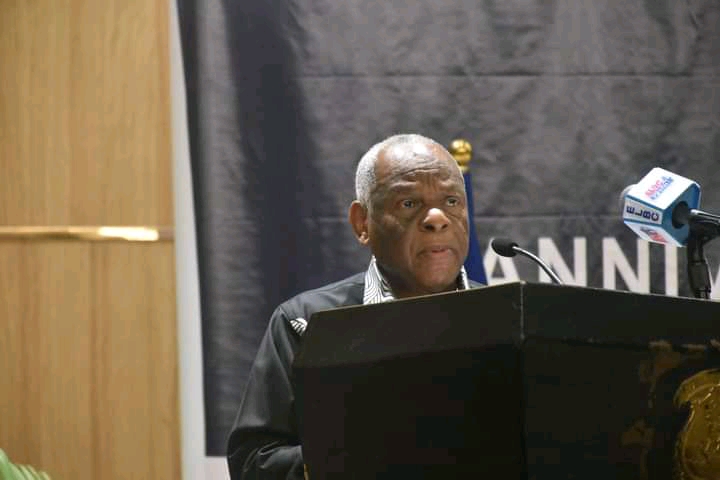
I thank Prof. Dr. Jonathan Taylor, Vice President, of the University of Liberia, for his powerful introduction.
I have come on this February 15, 2022, to celebrate and meditate with you on your Bicentennial Festivities and the future of this great country, especially in terms of education. I bring you greetings from the brothers and sisters in Philadelphia, an old African city, the seat of much activity to improve America. Voffee Jabateh, the leader of ACANA, our Philadelphia association for Africans, Caribbean Africans, and African Americans, seeking to build Africa Town in Southwest Philadelphia, sends special blessings.
Philadelphia is the source of many innovations and initiatives. Many of you trace your history to Philadelphia.
Afrocentricity as an African concept was born in Buffalo, New York, in 1980, but took root in Philadelphia and has spread around Africa and the world. Japanese, Russians, Britishers, and Chinese, have latched on to this idea. As the creator of this idea, I am happy to personally introduce it in Liberia as I have to other countries in Africa and the world.
I come to you in the name of Ptah, Aten, Ra, and Amen, the earliest names of God we know.
I pour libations and give thanks to the names of Gabriel Baccus Matthew and
Antoinette Brown Sherman, the Mother of the Revolution, and praise the brilliant men and
women who have led you this far. You have many men and women who shall live forever. Your ancestors’ names ring with the freedom and independence of other nations on this continent.
I am the sum of my readings, experiences, and influences and I humbly bring this message to you.
I bow before the various heroes and heroines who have insisted on maintaining democracy although we know that of all political systems democracy’s fragility is dependent upon vigilance.
You represent a powerful example of hope, integration of peoples, and the vision of a new age of Pan African democracy. I am here to testify to your overwhelming sense of the love of freedom, traditions, and good character.
Two of my former students, Prof. Dr. Edward Lama Wonkeryor, Director of Higher Education, and Prof. Dr. Sarr Abdulai Vandi, a former minister, are among those who have made international history as representatives of this nation. They were introduced to my earliest thinking about Afrocentricity in the Afrocentric Idea, the Afrocentric Manifesto, and Kemet, Afrocentricity and Knowledge. It has become the most dominant African philosophical idea in many universities and has impacted our thinking in the United States. Of course, the connection between Liberia and the United States is cultural, political, and social. So, I am sure that the idea behind Afrocentricity is here as well.
It is a simple idea, controversial to those who deem the interrogation of African cultures aberrant, but Afrocentricity is extremely resilient. There is nothing more important as lessons to us than our own historical experiences, ancient and modern.
Africa owes no debt to any people; all debts have been paid, even sometimes paid when they were not even made by us.
Afrocentricity is the idea that African people and interests must be seen as subjects, actors, doers in all areas of life. We are not merely receivers, spectators, and on-lookers to history; we are makers of history. All narratives of ethics, law, religion, language, architecture, sciences, and values must take the centrality of African experience into consideration. What have we thought about this or that? Who are we collectively?
I was born in Valdosta, Georgia in the deep South of the United States with all the baggage that such a birth came with in the l940s. I was given the name Arthur L. Smith, Jr., named after my father. After attending the University of California, Los Angeles, receiving the doctorate degree, I wanted to travel to this continent, Afterall it is the land of my origin. One of the six nations I visited was Ghana and that is where the Asantehene Opoku Ware II declared that my name should be Kofi Kete Asante. I later added Molefi out of solidarity with the South African struggle for liberation. The Ghanaians in Akyem, Tafo, enstooled me as the Kyidomhene of Tafo, Nana Okru Asante Peasah. The Amiru of Gao, Hassimi Maiga, made me a Wanadu in his court.
I later discovered through DNA that my immediate ancestors originated among the Yoruba in Nigeria and the Nubians in Sudan.
I lived in Zimbabwe, trained the first set of Zimbabwean journalists, after the Second Chimurenga.
Like so many of you, my history is complex, some of it is known, some remains unknown, but one truth I know: Africa is the origin of humanity, and my aim is always to examine the experiences of this continent. That is the only way to a true Pan Africanism.
Today I challenge Liberia to assume its rightful place as the modern assertion of a true integration of this continent in a Pan African way. You do not define your history; your history defines you. Our task is to make a new future grounded on African ideas and values.
We have often been betrayed by believing that Europe is teacher, and we are pupils. On the plane over here, I heard a white American sounding every bit like he was the leader of a plantation. His language, his attitude, his ignorance was palpable, and as we do, we just looked at him and let him demonstrate his southern American arrogance. Most of us in line for the flight ignored him.
Pan African is not merely a theory and a slogan, but a practice.
The African Renaissance is a concrete practice of Pan Africanism. What country is best prepared by experience and history to lead such a renaissance for the continent? Liberia is prepared, also, by its ideological, security, economic, and social history with the United States.
I am giving this challenge to Liberia. You must make the Diasporic pivot and claim for Africa all its contributions and achievements. No nation is more qualified than you to become the striker for African unity.
To do this, we need radical thinking in the sense that we must question ideas that come to us without paying homage to our ancestors.
Who and what are the traditions of beauty, the good, the most important traits of ethics?
My question has always been, “Who said so, and why?”
Did science come from the Greeks? Who said so?
Homer was the first Greek that made sense and he lived around 800 BC. He wrote the Iliad and the Odyssey, but they were written after he came to Africa.
Two thousand years before Homer there was Imhotep, the first genius in the world, because he was an architect, the first physician to study diseases and provide therapies, and he built the first pyramid.
The pyramids of the Nile River valley are the largest and earliest readable archives in the world.
Science is here, the liberal arts, rituals and ceremonies, the names of the Gods, the calendar, chemistry, and astronomy. This is 2500 years before Jesus and 3100 years before Muhammad.
You here in this fabled country, through a history of courage, and devotion to the idea of a universal African community have demonstrated more than most nations the acceptance of people from other communities. It is no wonder that the University of Liberia has become the fertile ground for the idea of African Diaspora Studies. This pivot will allow you to advance a thousand-fold and bring many other people and nations to honor the work you will do.
I am truly pleased to be able to examine the faces of those who have the courage to return to the study of the children of the motherland. Your children are everywhere.
Liberia is not a static idea; it is a dynamic idea, one that evolves every year and becomes more and more the country that opens its hands to all Africans. This is your history; this is your destiny.
Two hundred years of Pan African community through trials and tribulations, right here on the powerful bicep of Africa, you are now launching a truly Afrocentric initiative. What a glorious history and sentinel country you have become?
Liberia has had recently, more than twenty years of unbroken peace, you have committed yourself to the rule of law. His Excellency, President Weah made this pledge and has kept this promise in honor of the Press, collective associations, speech freedom, and the rule of law. When he spoke to the United Nations he was clear about his commitment to freedom; that is the true Liberian spirit. Let us also be true to ancient achievements of Africa itself.
Inzalo Y’langa, the place of the rising sun, in South Africa, is over 100,000 years old. It is the place where humans stood stones up in honor of the ancestors. They say it is the first structural creation by humans.
President Nelson, I come to tell you what you know and that is we must maintain vigilance, and encourage democracy, individual and collective rights, and the rule of law. The University of Liberia sits at the front steps of our adventure in African Diaspora Studies.
It is the respect for the rule of law that will enlarge opportunities and freedom and make this proposal for a program in Migration and African Diasporal Studies practical, real, and beneficial for the nation and the world. It must not be based on ethnicity, region, and creed, but on the collective sense of what is African. Of course, it is not a closed system, and we can always debate the principles of Africanity.
Martin Luther King, Jr., once said that some laws were unjust and that we must accept even the punishment that comes with breaking those laws because it shows respect for law. You then work to change the laws. That is why he and his followers went to jail. It is a noble thing to accept law; even though it is a poisonous idea to make bad law just to oppress other people.
Here in this enclave of liberty, you are now perched on top of academic possibilities, with an eternal future. I am here to encourage you to model the best traditions and practices for Pan Africanism in education. Ask the hard questions about our future, and our past?
Resolve to connect, not to separate. You can and must rise above ethnicity, protect the smallest and least protected groups, honor them, and you honor the meaning of Liberia.
Why are there tens of millions of Africans, the Siddis, in India? What nations did Cheng He of China trade with on the East Coast of Africa in the 14th century?
What is the model for the so-called Secret Societies? We know they are not secret societies because we know them, but they are societies of secrets: actually, they contain the texts, the poems, the drama, the healing information, and the narratives of our existence.
Let me give some facts:
The oldest hominin fossils are found on this continent: Sahelanthropus Tchadensis is 7.2 Million Years.
Homo sapiens, modern humans arose nearly 300,000 years ago here in Africa.
The first people to migrate were Africans, because there were only Africans in the whole world as Homo sapiens, modern humans, until Africans left the continent to go to Europe, Asia, America, and the islands in the seas 70,000 years ago.
All humans have DNA from Africa. This is the most diverse continent. The nearly 2 billion people on this continent represent more diversity than the rest of the world combined.
Africans knew diversity but did not rank diversity. The ranking of diversity is something that came with the Arabs and Europeans. It may have existed before that time with the ancient religions of Hindu, with their varnas, the caste system, and Judaism with its stories of Shem, Ham, and Japhet, as well, but it is not African. There have been aberrations in Africa in more recent times, but the earliest values of Africa were founded upon the ethics of Maat, the oldest ethic in the world.
African Proposal
Let me congratulate you for setting the model for African Global Studies with the Center for Migration and the Diaspora. Traditions come from doing something, and what you do will set the path for others to follow.
There should be key principles that we adhere to:
- The first migration was African. Homo sapiens exploring. First explorers and adventurers.
- The first nation was African, Kemet; integration of 42 ethnic groups by Menes, whose names exists in written history as a king.
- The first ancient civilizations were African: Kemet, Kush, Meroe, Nubia, Axum
- The first Mother and Child was Auset and Heru, often called Isis and Horus
- The first divine trinity was: Ausar, Auset, and Heru, often called Osiris, Isis and Horus.
The Organization of the Center for Migration and Diaspora Studies should include Classical Studies, Major Migrations, Forced Dispersions, The Liberian Example
We need to have Early and Classical Studies: Nile Valley Civilizations where we find the first diffusion throughout the continent. What did we know before we knew Europe and Arabia? Arabs arrived in Africa in 639 under General El As.
Why did we lose that knowledge? Who stole it? George James in Stolen Legacy declared that the Greek knowledge was found first in Africa. In my book, The History of Africa, I have told our own stories in our names to re-signify our ancestors and actions. We had kings and not just headmen or chiefs. We were kingdoms, nations, and families, not tribes; that is why I say ethnic groups. To use the language of hierarchy inherited from conquest is to remain stuck in domination and oppression.
Major migrations from Africa: Neanderthals, Homo Erectus, Homo sapiens
We need to have sections dealing with Forced Dispersions: the Maafa, from the Islamic and Christian Intrusions into Africa; African Indians in India and Indian Africans in South Africa, and other such examples in a world sense.
The Liberian Context is the perfect arena for this pivot to the future. We have learned and we can learn from it, transcending issues of ethnicity and race.
One can never forget the epic and courageous Return to Africa in 1822, and now in a new moment in history we will not forget this celebration 200 years later in 2022. It is the history that is the source of a powerful initiative. Making use of the collective histories of all peoples of this magnificent country will lend credibility to this pan-African launch for the Center for Migration and the Diaspora.
What is 200 years? It is six generations out of the many thousands since the appearance of humans on this continent.
We need to share in all African achievements and not become sectionalized and fragmented by ethnicities, so-called races, and regions.
Europe and Arabia cannot be our teacher in ethics and values, but both areas of the world have organized their academies: Pan Arabic and Pan European Academies. China has organized the Confucius Institutes with the idea of promoting cultural traditions. These academies of other people have their own rules, major philosophers, academic leaders, deans of knowledge, and missions.
Every one of Africa’s children, who left here, long before the Enslavement, sees the continent as the source of the future. Therefore, we must have our own idea even as we weigh the ideas of others. We have learned and we will learn from others, but we must first taste the cooking of our own mothers!
For Africans, we must overcome ethnic divisions. In the Ivory Coast, I asked an educator, why he was naming his new school after Montesquieu who supported slavery? Why not name it after Blyden or Diop? He asked me, “Isn’t Diop a Senegalese?” Yes, I said, and Montesquieu is French.
Let us be clear: Voltaire, Dante, Edgar Allen Poe, Hemingway, Shakespeare, Goethe, are all accepted in the Pan European Academy regardless of nationality.
Why aren’t books by African scholars, African Diaspora scholars, common reading in our classes? Who said that only Europeans could write this or that? To have a Center for Migration and Diaspora Studies is powerful, but it must truly teach us how to love ourselves, our traditions, our teachers, our philosophers from the entire African world.
So, we share, I share, and I know my own history is global.
Our aim must be to study the interaction between humans for patterns and models of good community behavior. In my new book, Being Human Being: Transforming the Race Discourse, written with Nah Dove, we asserted the idea of human beingness regardless of color, creed, gender, or class as the key to a truly human future.
Africans are global people and the fact that Iceland’s Ms. Universe in 2019 was of African heritage is a recent example of dispersion.
But an older dispersion happened over the past five hundred years due to our encounter with Europe.
In 1441 a Portuguese ship took Africans from the Senegal River region to Lisbon to open what would become the European Slave Trade. I do not call it African Slave Trade or Trans-Atlantic Slave Trade, or Trans-Sahara Slave Trade; the ocean and desert did not do anything to Africans. That is why I say European Slave Trade and Arab Slave Trade, which predated the European dispersion of Africans. The first revolt by Africans who were enslaved was the Zanj Rebellion in Baghdad in 900 AD.
Let no one tell you that Africans started the international slave trade; chattel slavery of others was never in Africa’s history until Arabs and Europeans came to the continent. Were there African collaborators? Yes, but there will always be collaborators. During apartheid in South Africa there were black police, but apartheid was not an African initiative. In all of my studies I have not found where African culture or people made slavery the principal mode of production.
The Center for Migration and Diaspora Studies must be beyond ethnicity, color, religion, and language in its acceptance and analyses of the African diaspora. Yet to be beyond ethnicity and color does not mean to ignore who you are, your heritage and traditions, but to accept the same from, and for other people.
The Center should be fiercely Afrocentric, grounded in classical African texts, articulating a common narrative of excellence and victory, asserting the liberation of women, while understanding a global Africa as the producer of knowledge, and dedicated to resisting all forms of domination.
We must accept all contributions of those who claim Africa:
The great African James Weldon Johnson went to Institute of Pacific Relations Conference in Kyoto Japan in 1929, and spoke for us.
Bob Marley of Jamaica claimed his African heritage wherever he went;
Pedro Camejo hero of Venezuela independence war in 1810 and 1823 distinguished us with his valor;
Dessalines defeated Napoleon’s general, Le Clerc, in Haiti;
Joseph Auguste Anténor Firmin was a Haitian scholar, 1885, wrote De l’égalité des races Humaines as an example of the defense of Africans;
Edward Wilmot Blyden from the Virgin Islands established himself as a major scholar in Liberia;
Onyebuchi Pamela Ashley Uba is a scientist and model and the first black woman to be crowned Miss Ireland in that nation’s competition;
Abdulrazk Gurnah is an academic, novelist, and first Tanzanian writer to win the Nobel Prize in Literature, first African to win the award since Wole Soyinka of Nigeria and Toni Morrison of the United States in 1993;
Russian shipbuilder and military Gen. Mikhail M. Egypteos built ships for the Russian empire. And before him, Alexander Pushkin dedicated himself to making Russian literature a world literature;
Vicente Guerrero, first president of Mexico, first black president in North America, outlawed slavery of Africans in 1829;
English actress, singer, and songwriter Cynthia Onyedinamanasu Chinasaokwu Erivo was born in London, England, of Nigerian parents;
Political novelist Al-Tayyib Salih, whose family background was both Arab and Nubian, was one of Sudan’s most significant authors of the 20th century;
.
Joanne Marie Anderson is the first woman of color to win election as mayor of a major city the United Kingdom and the first Black and first female woman mayor of Liverpool, England;
Kedist Deltour was winner of the 2021 Miss Belgium beauty pageant. At the time she was 24 and a native of East Africa. Born in Ethiopia’s capital city of Addis Ababa on July 29, 1997;
Nah Dove, one of the most brilliant thinkers of African descent, lived in Ghana, Nigeria, Sierra Leone, and England, wrote the books African Mothers and Afrocentric School to re-start an initiative in positive education;
Bella Forsgrén is the first black woman elected to the Parliament of Finland;
Aida Cartagena was a prominent Afro-Latina poet, novelist, scholar, and public intellectual;
Maria Firmina dos Reis was the founding mother of Afro-Brazilian literature;
María Teresa Vera was an Afro-Cuban guitarist, singer, and composer, who is held up as an example of the Cuban “trova” movement;
Abdias do Nascimento, the greatest Afro-Brazilian Pan Africanist, nominated for the Nobel Peace Prize, poet, philosopher, actor, senator, and scholar;
W. Rudolph Dunbar was noted as a genius at the age of nine for his musical genius in Guyana;
Virginia Brindis de Salas was the first published black woman writer in Uruguay. She was born on September 18, 1908 in the capital, Montevideo;
Strive Masiyiwa is a Zimbabwean businessman and philanthropist. He is best known for being the founder and chairman of Econet Wireless International and Zimbabwe’s first billionaire;
Victoria Eugenia Santa Cruz Gammara is widely considered the mother of Afro-Peruvian dance;
Milton Samuel J. Wright. Ph.D. in Economics from Heidelberg in Germany was the only person of African descent to speak at length with Hitler in 1932;
Brita Abiba Þórhallsdóttir (the Icelandic letter Þ is the equivalent of th in English) was born January 9, 1999, and became Iceland’s Ms. Universe.
The glorious names of Liberians are too many to name, but you know them, and can cite them because I am certain you study them in school.
Our challenges are great, but our victories are certain. Liberia with its wings setting sail toward a new century can bring into being an Africa free of hierarchy and patriarchy the parents of racism, oppression of women, brutality against numerical minorities, and classism.
On this continent the first queens in the world ruled: Sobeknefru, Hatshepsut, Cleopatra, Amanirensis, Amanishakete, Idia and hundreds of others. Nubia still ranks as the ancient culture with more queens than any other nation.
On this continent homo sapiens first called the name of God.
On this continent we established what was edible and what was not.
On this continent we established the names of the days of the week, the annual calendar, and called the stars by their names.
On this continent and in this fertile nation we will plant the seed of Migration and Diaspora Studies.
So, we have challenges, but we have always overcome them.
You are not an insular people; you are a global people.
While some of you are descendants of those who spent over 200 years in America from 1619 to 1821 and another 200 years since the Elizabeth landed in 1822 and others of you have spent 50,000 years or more on the Windward Coast, you are one people, democratic, energetic, and noble. Your nobility is unquestioned and now you must rise again and take the new century by launching this Center for Migration and Diaspora!!
Molefi Kete Asante is Professor of Africology and African American Studies at Temple University. Considered by his peers to be the most published African American scholar with 97 books, including The History of Africa, and 500 articles, he has trained 140 Ph.D. students. He is the founding editor of the Journal of Black Studies and the major proponent of the Afrocentric paradigm.
 MONROVIA LATEST NEWS