Lofa County- September 30, 2021: At this year Press Union fifty-seventh anniversary celebration in Lofa county, the president of the Union has called for United in the organization. The PUL President, Charles Coffey has called called on all Journalists who are staying away from the Union to come back to Union. He made the statement at the official program marking the celebration problem.
Here is his Full statement below:
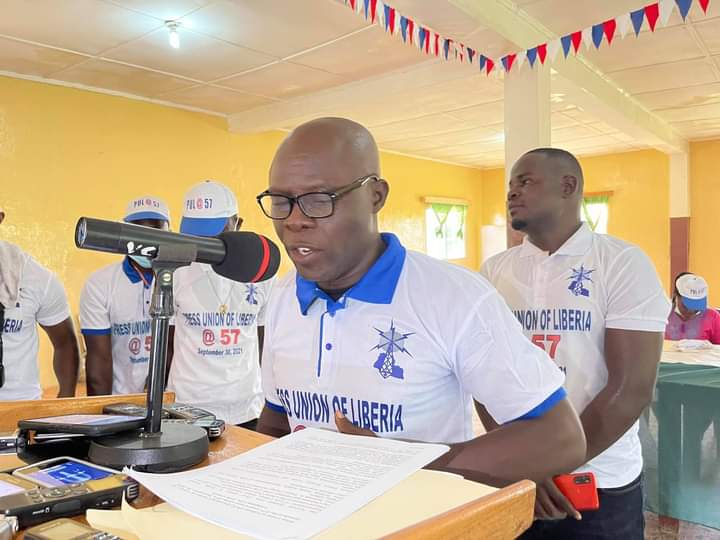
Press Union of Liberia (PUL) President Charles B. Coffey, Jr, Speech at the 57th Anniversary of the PUL September 30, 2021, Voinjama City, Lofa County
Our Keynote Speaker Hon. Chief Moses Y. Kollie, Former Representative of Lofa County, former Minister of Labor, and now Director-General of the Liberia Civil Aviation Authority;
The Chairman and Members of the Lofa Legislative Caucus,
Hon. Jarlawah A. Tonpo, Deputy Information Minister for Press and Public Affairs,
Hon. William Tamba Kamba, Superintendent of Lofa County, and other officials of government,
Chiefs, Elders, Women, Youth, and Traditional Leaders of Lofa County;
Mr. Daniel Nyakonah, Jr, Vice President of the Press Union of Liberia, the Secretary-General, Musa M.B. Kanneh, and Assistant Secretary-General Akoi M. Baysah, Jr; Former officials of the Press Union of Liberia and Heads of various Axillaries of the PUL,
Madam Chairperson Melody Mezay Ketter and members of the 57th Anniversary Committee;
Media executives, Mr. Tokpa Tarnue, PUL Coordinator of Lofa County, the host, other county and regional coordinators of the PUL, media workers, members of the Press Union of Liberia;
Ladies and Gentlemen
We praise God the all-powerful, ever-present and the most merciful, for keeping us alive under this global pandemic COVID-19 that has and continued to destroy lives. Indeed, If you want to know a true friend, a true neighbor as an individual, or as a nation, get in crisis, then you will realize that God is a true friend. Praise be to God for bringing us to Lofa despite the numerous travel challenges.
We are also grateful to the people of Lofa County for highly embracing us from the 15 sub-political divisions of our country. The warm reception, the people of Lofa accorded us will always be remembered. Lofa is a county of love, peace, and unity. They are people who respect visitors. God will continue to bless the people of this great county.
Mr. Guest Speaker, platform guests, ladies and gentlemen, celebrating the PUL 57th Anniversary under this favorable environment in Lofa despite the global pandemic, requires perseverance, and commitment to the call of duty. So I humbly salute every Liberian, journalists, media workers, and foreign partners for this peaceful celebration. I am also grateful to the Anniversary committee for ably executing its task.
Historical Perspective of the PUL
We are celebrating the Press Union Liberia (PUL) anniversary as a result of the purpose of its formation and its core values.
As you may be aware, the Press Union of Liberia was founded in Monrovia on September 30, 1964 for the sole purpose of advocating for press freedom, freedom of expression, the protection and safety Journalists, as well as social justice.
The foundation of the PUL grew out of a legislative contempt action against journalist Stanton Peabody. In the succeeding consultations, the Journalists in attendance, E. Reginald Townsend; Henry B. Cole, Chauncey Cooper, Aston King, Tuan Wreh, J. Perey Gumel, and Stanton Peabody agreed to organize an association to protect journalists.
These individuals have served the journalism community and defended the values and norms of the Union. The PUL currently serves as the umbrella organization for Liberian media professionals and institutions.
With a membership of more than 1,000 journalists, the PUL has oversight responsibility for addressing problems arising from journalist’s reportage and conduct in the face of the ever growing demand for media quality and good taste.
Hon Guest Speaker, officials of government, fellow media colleagues, during the period under-review, the Union has grown into a vibrant Pro-Democracy group that has championed not only media matters, but issues affecting the democratic governance of the state, social justice and human rights.
Throughout the prolonged Liberian civil crisis and the proceeding years, when almost every strata of the Liberian society was polarized on factional and political lines, the Press Union stood as a defiant non-partisan institution that challenged the regimes in spite of the associated risk.
Before the 60s, the Liberian Press only concerned itself with government handout, or releases from embassies along with news from business houses and schools. However, with the establishment of the Union, the Liberian Media have experienced some transformation, but much is desired in the face of the global pandemic and difficult economic environment of the media.
Amidst the unfriendly space at the time of its establishment, the Union has developed and has since been working to seek opportunities for the Liberian Media as well as defend Press freedom.
The PUL provides small support to journalists who are in distress if and when it has available resources. The Union currently, operates through four elected officials comprising: President, Vice President, Secretary-General and Assistant Secretary-General.
Five standing committees are appointed by the elected leadership to form the Executive committee that serves as supporting arm of the leadership in moving the Union forward. The Executive Committee is the highest decision making body of the Union next to the general membership (Congress).
The Union has also been decentralized with 15 coordinators within the 15 sub- political divisions of the country to steer the affairs of the PUL. In furtherance of the decentralization structure, the Union also has regional coordinators who are coordinating the activities of the county coordinators.
PUL actively collaborates, partners and networks with several local and International Organizations including, the International Federation of Journalists (IFJ), the Federation of African Journalists(FAJ), the West African Journalists Association (WAJA), Committee to Protect Journalists (CPJ), Global Forum for Media Development (GFMD), USAID, OSIWA,, UNDP, IREX/ Internews, Carter Center and others.
Reconciliation
Reconciliation, unity and harmony serve as perfect recipe for institutional advancement. As a leadership and servants of the people, we must always foster peace, unity and reconciliation social cohesion.
Therefore, as president of the PUL, I am again, using this occasion to re-emphasize the need for more solidarity and unity among us, as media people.
I am calling on all of our colleagues who are staying away from PUL activities for one reason or the other, to return and let us forget our differences and remain united for the common good of the PUL and our country. PUL is our common denominator and we must keep the touch burning. I as president of the PUL is giving this olive branch.
I have come with peace, unity and reconciliation.
Progress in Liberia/ Achievement in media Freedom
The PUL has achieved a lot in terms of media freedom and freedom of expression through policy formulation and the repealed of some draconian laws that were impediment to media freedom. PUL achievement is predicated upon President George M Weah political will and his government quest to ensure freedom of the press and expression in conformity with the organic law of our land, the Liberian constitution.
The constitution guarantees for all citizens the rights to free speech and the freedom of expression, being fully responsible for the abuse thereof, consistent with constitutional guarantee to free speech, the right to opinions without interference and the right to knowledge and information, the Liberian government has in 2010 enacted the freedom of Information Law and established the Independent Information Commission, to ensure access to information.
‘’Access to information’’ refers to the right of the public to request, receive, review, reproduce and retain records and documents held by public bodies and private entities performing public functions or receiving public funding.
The objectives of this act includes : to promote effective, equitable and inexpensive exercise of the right of access to information; To establish clear and concise procedures for requesting and providing of information held by (i) public bodies and (ii) private bodies receiving public benefits of performing functions or providing public service, to establish and provide for the exercise of a right to appeal any decision denying a request for information of infringing on the right of access to information; and to provide appropriate penalties and other sanctions for wrongful failure to keep and or provide information.
An oversight body, Independent Information commission was established to ensure the implementation of the act, including compliance.
Also in demonstration of its commitment to upholding freedom of speech and expression, the Liberian government signed the declaration of Table Mountain which among other things require that African states must recognize the indivisibility of press freedom and their responsibility to respect the freedom, independence and safety of the press.
The Declaration of Table Mountain demands further that as a matter of urgency, African states must abolish “insult” and criminal defamation laws, at the time in Liberia, it has been determined that the penal law of Liberia contains some provisions which have the tendency to impede freedom of expression contrast to the spirit and intent of the Declaration of Table Mountain and other International Conventions; It has further been recognized that freedom of speech and expression promotes democracy, good governance as well as the rule of law which is a sine qua non to the development of any nation.
In furtherance of the Press Freedom, this current Liberian Government under President Dr. George Manneh Weah and my administration as president of the PUL, repealed in their entirety several provisions of the Penal Law of 1978, on February 28, 2019 . The repealed sections include 11.11, Criminal Libel against the President, 11.12, Sedition and 11.14 Criminal Malevolence. Liberia is one of several countries in the world and few in Africa to abolish criminal defamation law and establish freedom of information law. Credit goes to all of us as Liberians and as a nation.
These are also some of our achievements as an advocacy group for free speech, media freedom and social justice. In this public manner, we again commend President George Manneh Weah and government for the political will which enable us as a nation for success. We also commend you Mr President for your many supports to the Union in furtherance of press freedom and free speech and ensuring dignity for media workers.
Towards this, we like to appeal to the Liberian government, through you Mr. President assist with our headquarters project which has been stalled due to the COVID-19 and other challenges we are faced with as an institution. We are hopeful of your assistance because of your unyielding quest to build a strong infrastructural country.
The PUL has also made significant progress in its decentralization policy. The PUL presence is being felt across the country, with members of the Union, journalists and media workers ensuring press freedom and freedom of expression through the media, Liberians and foreign residents within the territorial confines of our country are freely expressing themselves without fear.
As a result of media freedom, we are experiencing growth, evidence being the proliferation of media institutions, including the new media, citizen journalism, journalism and communication institutions in the country. More people are now venturing in media business, unlike many decades back, when people were reluctant to take on journalism profession because of fear, either to be killed, or to experience harassment and intimidation. The PUL will continue to ensure a conducive operating environment of the media.
Collective Bargaining Agreement
The current working conditions of most journalists in Liberia represent a major impediment to their capacity to perform in line with professional ethics and professional obligations. Poor condition of service for journalists remain a major concern in the country. Thus the status and state of the Professional organization which often seeks the basic capacities and means to design sustainable, progressive programs of action on behalf of their members required immediate and direct Interventions of media owners, if realistic prospects for meaningful change were to be realized.
Many journalists working in the country have no job security. They are deprived from any form of social security, health benefit, while some are owed numerous months of salaries. Closely related to this, is the fact that many Liberian journalists, particularly those in the lower cadre who work as reporters are poorly paid and ill motivated which partly explains the poor performances of some of these journalists and most importantly, the continuous disregard of the ethics of the profession.
In the light of these critical issues, there has been a clarion call for a collective bargaining standard framework that will to some extend determine what journalists are paid, their conditions of service in relation to the qualifications that they have and their level of professionalism.
The Union is in the forefront of this crucial course and is confident that the desired results will come sooner rather than later. Already there have been great strides in this regard in Liberia.
Standard Collective Agreement has been developed while collective negotiations have been launched at national level.
However, there still remains a herculean task ahead. Most media owners and executives have often not been committed to any form of collective bargaining agreement for their workers, while the appalling economic condition has worsen the situation. PUL has earlier planned media economic conference, but it did materialize due to the COVID-19 outbreak, which disallowed our good media partner, the European Union Delegation to Liberia to hold the conference.
The European Union delegation was working with PUL to hold the conference. We are optimistic, that with the cases reducing and people are being fully vaccinated, we will by the grace of God hold the media economic conference and at the end we will develop the business model of the media.
Notwithstanding, some media institutions including print and electronic have gone beyond the bench mark of the draft PUL collective bargaining agreement.
These media outlets are paying journalist between 100 and 200 as beginner and between 300 and 500 and above USD for editors depending on the status of the journalist or media workers.
We are calling on most of the media institutions that far below the belt or lacking behind to double up. Journalists and media workers deserve the best remuneration and other benefits. We also calling government and business entities to do more advertisement in the traditional media and not just social media. This will help improve the media economy. The poor media economy is forcing many grass root media institutions into self-censorship.
OUR THEME: ENHANCING THE VOICES OF CITIZENS AND GOVERNMENT FOR SUSTIANABLE DEVELOPMENT
Earlier, on Wednesday, because of the significance of freedom of expression and in conformity with this year’s anniversary theme, enhancing citizens voices and government to sustain development, traditional leaders, and other citizens of Lofa participated in the special edition of the Edward Wilmot Blyden Forum to have conversations on the current state of affairs of our country particularly enhancing citizens and government voices to ensure development. Hearing from people with diverse views is the best recipe to ensure peace, unity and do away with vehement violence. We are obligated to make state actors who governed our country and non-state actors who are prominent people in society to account to the public while, doing so, we must understand violence to better prevent it.
Remember, the violence which is experienced by the population, Political Actors, leaders and the International Community takes root from the historical, political and Socio-Economic parameters.
Pending Bye elections in some of our counties
The media must play its social responsibility role to ensure peaceful bye elections in the counties concerned, to prevent election violence. Understanding causes of conflict with proactive journalistic approach will help prevent violence.
As regard to complexity and shorter, causes and consequences of elections, the main motivation for violence at elections is to influence the result. That means the violence is used as a manipulative tools along with other action.
Free elections constitute one of the fundamental pillars of participatory democracy; so it should be guided by the media with the responsibility to promote and help facilitate an enabling atmosphere for the free and fair conduct of elections.
As required by the PUL election coverage guidelines for journalists of May 2, 2017. Journalists duty to parties and candidates, journalist including talk show hosts have a responsibility to be accurate and impartial in their coverage of election issues and candidates with all given opportunities to be heard and question.
While columnists, editorial writers and other commentators may express their own individual views about election issue and candidates, those subjective opinions should be clearly separated from and have no influence on the objective news coverage, provided by those same media outlets. News and opinion should each be clearly identified as such, and should be separated in their placement and treatment in both print and broadcast media.
MEDIA AND SECURITY RELATIONS
In Liberia the issue of press freedom has improved significantly, but there are still obstacles to fostering press freedom and freedom of expression. These include tensions and sometimes confrontational interaction between security forces and journalists. One of the major sources of tension occurs when journalists are trying to access information, for instance, the security can doubt the legitimacy of the journalists’ sources, whereas journalists often find information from security limited or not delivered in time for their deadline.
Now, at that point, there is a discrepancy between journalists need for information and the ability of security forces to provide them with the necessary kind of information and authorization. Now, any measures the state takes, which limit freedom of the press either directly or indirectly are prima facie interferences with the right of the media.
It is important for both the security and the media to respect each other and a memorandum of Understanding signed few years back.
The memorandum defines the ways in which they must treat each other and citizens right to freedom of expression.
In a climate where journalists are safe, citizens find it easier to access quality information and many objectives become possible.
Investigation
Recently, Journalists Trojan Kiazolu and Hannah Geterminah were assaulted by some police officers at the Ashmun Street Police Station. The situation was referred to the police authority for investigation.
As I report, the case has been investigated and findings provided indicate that the police officers were found guilty and they have been suspended with pay cut
Also journalist Ballah Zezay was also assaulted by LNP officer Joshua During. The case was investigated and the officer was found guilty and also suspended. This latest development is welcoming and we trust it will serve as a deterrent for who be violator of the law.
Whenever, journalists or media workers go wrong the union as usual will also act in timely manner to ensure justice. Everyone is equal before the law. It is important that we reciprocate. We are also calling on the Bropleh committee to make findings of its investigation available as the Liberia national Police did.
We are optimistic that together we can foster peace, security and national development, if only we respect the rule of law. The gains we have made as a country in fostering press freedom and freedom of expressions are irreversible.
Health Issues/ COVID-19
The PUL is urging journalists and media workers who are yet to be fully vaccinated to do so now, for their safety and the safety of the other people. Government has effectively put in place measures to mitigate the effects of covid-19 on Liberians including journalists. We as journalists and media workers should set an example by taking the lead in the vaccination process. The leadership of the PUL and other media practitioners have been vaccinated fully.
The Union is collaborating with heath ministry to encourage all journalists to take the vaccine. Besides taking the vaccines the PUL leadership is urging all media institutions and practitioners to sensitize Liberians and foreign residents to take the vaccines so together we can defeat this common enemy, the Covid-19. This sickness is destroying the entire world, so everyone is concerned and striving to eliminate it.
Professionalism/ deportment
Fellow colleagues, in the wake of media freedom, Liberia is experiencing escalating wave of invectives and profanities by some media practitioners on some media institutions. This situation is undermining the relevance of the Liberian media.
We are urging all state actors and powerful non state actors in the country to join the Union in soliciting ideas aim at ending the escalating wave of invectives and profanities characterizing by some radio broadcast in the country.
It is important for power holders to pressure owners of the media concerned to instruct their subjects to end the use of vulgar languages during broadcast.
People are losing the news and information they need to make good choices for their families to participate in their communities and hold their government to account.
Misinformation and disinformation
There is global proliferation of misinformation, disinformation, and propaganda and hate speech. Trust in media and other institutions is plummeting or dropping. This shared global crisis that will only grow in magnitude as the next three billion people come online.
Most at risk, in every country, is local and community media, the connectives issue of professional and healthy media environments. As media struggles, bad actors and information have rushed to fill the gap.
While the flow of digital advertising revenue is steadily increasing, little is making its way to the media institutions who employ journalist and create original news content, while some global news companies have built strong digital advertising infrastructures, the vast majority of smaller and local media organizations do not have the skills or technical knowledge to participate in these fast-moving markets, dominated by increasingly consolidated digital platforms.
Liberia is of no exception of this global situation. We must counter misinformation and disinformation to ensure peace and stability in our country. Let us remember that the media is a double edged sword. It can be a terrible weapon of violence when it propagates messages of intolerance or disinformation that manipulates public sentiment.
The other aspect of the media that the PUL leadership wants journalists to continue to exhibit is to use the media as an instrument of the propagation of true messages for citizens to make an informed decision and choices, when the information it represents is reliable, respects human rights and represents diverse views.
It is the kind of the media that enables a society to make well informed choices which is a forerunner of democracy. Public enlightenment is the portent of justice and the ingredient of democracy.
The obligation of journalists is to foster those ends by seeking truth and providing a fair and comprehensive account of events and issues. Conscientious journalists from all specialties strive to serve the public with thoroughness and honesty.
If the media reports propaganda and is one sided that same media may also fuel tension and provoke conflict.
It can be an instrument of conflict resolution, when the information it represents is reliable, represent human rights, security policy, and represents diverse views.
A media which is controlled by personnel who apply professional ethics combined with national ownership and diverse access to information can contribute to societal cohesion, considerate, alter misperception and broaden understanding of causes and consequences of conflicts.
Let us not focus on political issues alone, but issues that are also affecting the ordinary people. The media should not just keep on talking about historical conflicts, telling people that current possible conflicts are unavoidable but it should talk words of tolerance and peace, in its contents the media should create an image that outbreak of conflict can be amicably resolved and return to peace is a number one priority of the society.
CHRONOLOGY
Fellow colleagues, death, man’s greatest enemy has tormented the PUL, thus taking away many of our colleagues, including Horatio Bobby Willie, two times Chairman of the PUL Excellent Awards Committee, Yede Allison of ECOWAS Radio, Janet Johnson, formerly of LBS and Radio Veritas, Zee Roberts of New Liberia, Charlesetta Miller, formerly LNTV/ LBS, Leo Gbarteah, Rev. Emmanuel Z Bowier, first Chairman of the PUL National Media Council and former Minister of Information, Melvin Gobah, formerly of the Liberia Media Center (LMC), Balinton Chea of the Voice of Tappita and etc. Aaron Nyangbe voice of Hope in Pleebo, Lewis Verdier Inquirer Newspaper Maryland county corresponding
May their souls and all faithful souls departed rest in perpetual peace.
Happy 57th anniversary with God’s bountiful blessing, peace and love upon us.
 MONROVIA LATEST NEWS