Monrovia-July 30,2021: President George Manneh Weah has described Human Trafficking as a repugnant and detestable act, which he says is a perilous menace, which encroaches upon the Human rights of an individual and poses grave treat to human dignity.
Here is the full statement below:
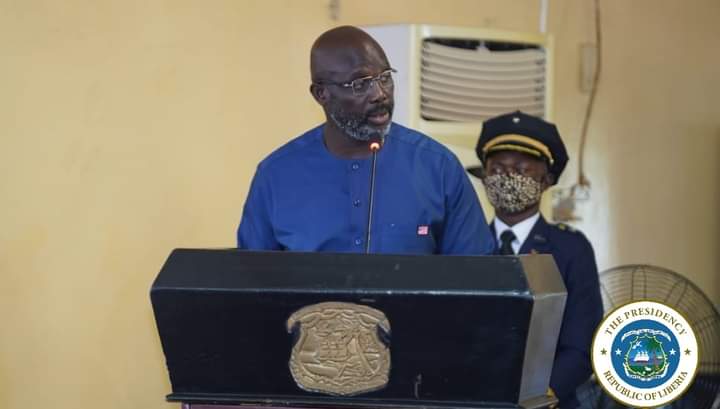
STATEMENT BY HIS EXCELLENCY DR. GEORGE MANNEH WEAH, PRESIDENT OF THE REPUBLIC OF LIBERIA, ON THE OBSERVANCE OF THE WORLD DAY AGAINST TRAFFICKING IN PERSONS, FRIDAY JULY 30, 2021
In observance of this year’s celebration of Word Day Against Trafficking In Persons [TIP}, I wish to emphasize the compelling responsibility of not only the Government, but every citizen and resident within our borders to exert meaningful efforts, leaving no stone unturned, in ensuring the minimization and subsequent total eradication of all forms of Human Trafficking in Liberia.
Human Trafficking is a repugnant and detestable act; a perilous menace, which encroaches upon the human rights of an individual and poses a grave threat to human dignity. In post conflict Liberia, cases of human trafficking have been observed to be occurring mainly within the territorial confines of the country, despite the promulgation of laws to prevent and fight trafficking in persons.
There is an increasing trend of Liberians and other nationalities being subjected to trafficking in the West African sub-region. The US Department of State in 2017 indicated that Liberia remains a source and destination for the trafficking of men, women and children, and that also women from Tunisia and Morocco have been exposed to sex trafficking in Liberia, and on the converse, women from Liberia have been trafficked to Lebanon. This is indeed troubling and must be stopped.
At the domestic level, the major streams of human trafficking occur from rural to urban areas, and the victims are usually faced with forced labor, sex trafficking, begging or domestic servitude. Unlike in other parts of the world, where traffickers operate through complex criminal networks, an essential feature of human trafficking in Liberia is that, most of the traffickers operate independently. Typically, the traffickers are relatives of the victims or friends of the victim’s parents. The crux of the issue here is that the traffickers often use the promise of a better life, as the bait, and later divert to subjecting the victims to street selling, domestic servitude or sex trafficking
The Government of Liberia has therefore made concerted and unrelenting efforts to address and ultimately eradicate human trafficking within its borders. The GOL passed the 2005 Act, which banned and criminalize the trafficking of humans in Liberia. We also established the National Anti-human Trafficking Taskforce, chaired by the Minister of Labor and C0-chaired by the Minister of Justice, with several lined Ministries, Agencies of Government, International partners and local NGOs as members. This task force is actually the principal vehicle coordinating, directing, monitoring and undertaking all program activities against human trafficking and Child Labor in Liberia.
Additionally, a number of key policy documents were developed, including “A Situational Analysis of Human Trafficking; The First and Second National Action Plans to fight Human Trafficking; The Standard Operating Procedures to assist victims of Human Trafficking; The National Referral Mechanism, which stipulates not only the roles and responsibilities of actors, but also referral programs and procedures for trafficked victims.
Liberia’s Anti-human Trafficking Framework is fervently anchored on the four pillars of Action:
Prevention-which entails the availability of laws, public awareness, education, effective intelligence gathering, surveillance and other proactive activities, etc.;
Protection-which entails care provision, secured homes for victims and other forms of supports to reduce anxieties and post-traumatic stress;
Prosecution-which entails the court process, which is the most fundamental step in the Government’s fight against trafficking; and
Partnership- which entails collaboration with local, regional and international partners and institutions for various forms of cooperation and support in the global fight against the trafficking of human beings.
The task of addressing human trafficking, along with all of its attendant socio-psychological consequences, can be huge and perplexing, particularly for a post conflict, developing nation, such as ours. Resource intensity, logistical, capital and human skill requirements, porous border management , deceptive and manipulative intrigues, are among our daunting challenges, while creeping social vices such as drugs use, domestic violence, abandoned children, broken homes, SBGV and juvenile issues, are some causative agents. We must therefore continue to exhibit the strongest of political will and relentlessly lend resource allocation and adequate support of immeasurable dimension to ensure that human trafficking is unequivocally combatted and fully eradicated from our society.
To ensure the success of this fight against human trafficking, the Government last month distributed US$150,000 to enhance the works of the taskforce and another US$200,000 has been authorized to strengthen awareness, intelligence gathering, prosecution, Law Reforms and protection of victims. However, a lot more is needed as some perpetrators thrive on the ignorance of the public to evade tracking and legitimize fraudulent activities by acquiring visas, passports, birth certificates, etc. The public at large must get involved with a community based all-inclusive approach in waging a robust campaign against this crime, including exposing all forms, manifestations, intrigues and workings of this criminal enterprise, which is manifested across various sectors of our society.
We would like to use this observance to once more thank the United States Embassy near Monrovia, the United Nations Office on Drugs and Crime (UNODC), the International Development Law Organization (IDLO), International Organization for Migration (IOM), Economic Community of West African States (ECOWAS), and International Labor Organization (ILO) and our many development partners for their concerted efforts assisting National Taskforce Against Human Trafficking carry on it national mandates and meeting our international obligation in curtailing and eradicating Human Trafficking in Liberia.
May God bless us all, I thank you.
 MONROVIA LATEST NEWS