
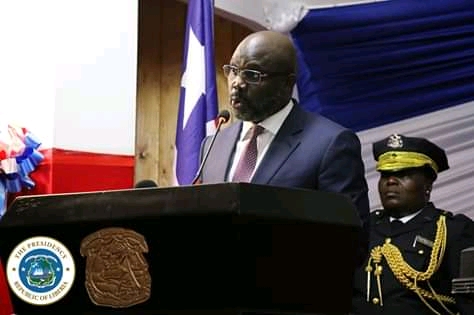
Full Text of President George M. Weah Annual Address To the 54th Legislature
Capitol Hill, Monrovia- January 27, 2020
Madam Clar Marie Weah, First Lady of the Republic of Liberia;

Madam Vice President and President of the Senate;
Mr. Speaker;
Mr. President Pro-Tempore;
Honorable Members of the Legislature;
Your Honor the Chief Justice, Associate Justices of the Supreme Court and Members of the Judiciary;
The Dean and Members of the Cabinet and other Government Officials;
The Doyen, Excellencies and Members of the Diplomatic and Consular Corps;
The Chief of Staff and Men and Women of the Armed Forces of Liberia (AFL);
Former Officials of Government;
Traditional Leaders, Chiefs and Elders;
Political and Business Leaders;
Religious Leaders;
Officers and Members of the National Bar Association;
Labor and Trade Unions;
Civil Society Organizations;
Members of the Press;
Special Guests;
Distinguished Ladies and Gentlemen;
Fellow Liberians:
I stand before you today, and through you before the People of this Republic whom you represent, to perform my constitutional duty in fulfilment of Article 58 of the Constitution of Liberia.
This provision of the Constitution mandates the President, on the fourth working Monday in January of each year, to present the Legislative Program of the Administration for the ensuing session, and report to you on the State of the Republic, covering the economic condition of the Nation, including expenditure and income.
Before I do so, I must ask you to join me in giving thanks to the Almighty God for watching over this Nation during the previous year, and for the many blessings He bestowed upon us as a People. He has faithfully guided our Ship of State through turbulent seas, and contrary winds, and has brought our Nation safely to the beginning of a New Year and a New Decade.
To God be the glory! For the great things He has done!
Madam Vice President, Mr. Speaker, Mr. Pro-Tempore and Members of the 54th Legislature:
Before we proceed further, let me seize this opportunity to applaud this Honorable Body for the sacrifices you continue to make in moving our nation forward, and for the spirit of collaboration and cooperation that we enjoyed during your Second Session, which culminated in the passage of an unprecedented Fifty-two (52) pieces of legislation.
In the interest of time, a listing of these new Acts is attached as an Appendix to this Annual Message.
Additionally, with your collaboration, we participated in a Presidential & Legislative Retreat in August last year, where we exchanged views and proffered solutions to address some of our pending constitutional issues. This resulted in a Resolution signed on three propositions to amend various Articles of the 1986 Constitution of the Republic of Liberia.
These three Propositions for constitutional amendment will be voted on in a Constitutional Referendum to be held later this year.
Proposition One on dual citizenship underscores the message that our children, grandchildren and great grandchildren will always be Liberians.
In this regard, we welcome the All Liberian Conference on Dual Citizenship to be held in Monrovia later this year, and look forward to our participation along with civil society, in the public awareness campaign that will lead to the passage of Proposition One, thereby enshrining into our organic law, the principle that once a Liberian, always a Liberian.
In the same vein, let me take this time to give a special salute to the Chief Justice and Associate Justices of the Honorable Supreme Court of Liberia for the recent landmark ruling that speaks to this truth: that once a Liberian, always a Liberian.
Proposition Two is the outcome of concerns raised by many citizens that the presidential and legislative tenures are too long. We have heard the cries of our people, and in response we have proposed a reduction in the number of years for these terms, going forward.
Proposition Three seeks to address our concern about holding elections during the rainy season in October. An adjustment has been proposed to hold elections now in November of each election year.
We therefore call on all of us to favorably consider these three Propositions which seek to amend our Constitution in the pending Referendum of 2020. They are good for our democratic space.
The commitment that you have shown by extending your Second Regular Session three (3) times, and again convening in a Special Session when we called upon you to act on several matters of urgent national concerns, have not gone unnoticed by us and the Liberian people. We can only be grateful, and thank you for your sacrificial and selfless service, as we look forward to future collaboration in the interest of national unity and development.
We say welcome back from your Annual Recess as you begin this Third Session of constructive dialogue and deliberations in the interest of our Nation and its People.
Madam Vice President, Mr. Speaker, Mr. Pro-Tempore, Honorable Members of the 54th Legislature:
As you begin this 3rd Session of the 54th Legislature, we urge you to consider the passage of other Bills still pending before you, which are very essential to our Pro-poor Agenda for Prosperity and Development.
We refer to the following:
The Convention of Mutual Administrative Assistance in Tax Matters; An Act to Establish the Liberia Standards Authority; An Act to Establish the Civil Service Commission;
Agreement between the Government of the United Arab Emirates and the Government of the Republic of Liberia for the Avoidance of Double Taxation;
Loan Agreement – Upgrading of the Konia-Voinjama Road Project between the Republic of Liberia and the Kuwait Fund for Arab Economic Development.
Others include:
An Act to Endorse the National Youth Policy of Liberia: An Agenda for Action; An Act Prohibiting the Tenure of Public Officials within the Executive Branch of Government; The Revised and Restated Charter of the University of Liberia; The Whistle-Blower and Witness Protection Bill;
The International Solar Alliance Framework Agreement;
The Presidential Transition Act; The Money Laundering, Terrorist Financing, Preventive Measures, and Proceeds of Crime Act, 2019; An Act to Amend and Restate “An Act to Authorize the Establishment of the Central Bank of Liberia”, which will enhance the autonomy and independence of the Central Bank of Liberia.
We also urge you to take another look at our forestry, mining and fisheries laws to inject new and innovative thinking, to include viable strategies for expansion of productive capacity, best practices for better returns and gains, as is the case in other jurisdictions.
Madam Vice President, Mr. Speaker, Mr. President Pro-Tempore and Honorable Members of the 54th Legislature:
We will also be submitting new legislation for your consideration, including a revised public health law, and a bill to amend the New Executive Law to create a new chapter to be entitled: Cooperative Development Agency 2020; Cooperative Societies Act of Liberia 2020.
During the period under review, four (4) Executive Orders were issued to address national imperatives:
Executive Order No. 94: Exempting the Liberia Electricity Corporation from Customs Duties and GST on Generation, Transmission and Distribution Equipment, Materials & Fuel;
Executive Order No. 95: Exempting the Liberia Water and Sewer Corporation from Customs Duties on Selected Items;
Executive Order No. 96: Instituting Certain Measures to Stimulate Economic Growth; and
Executive Order No. 97: Suspension of Tariff on Agriculture Products.
Madam Vice President and President of the Senate, Mr. Speaker, Mr. President Pro-Tempore and Honorable Members of the 54th Legislature:
I am mandated to report on revenues received and expenditure incurred in the year under review. Total revenue received amounted to Four Hundred and Forty-Five Million United States dollars (US$445 million). This is Thirty-Five Million United States dollars (US$35 million) less than revenue collected from January to December of 2018, or Seven point Two percent (7.2 percent). Total cash expenditure for the period under review amounted to Four Hundred an 8d Six Million ($406 million) United States Dollars.
Honorable Members of the 54th Legislature, Distinguished Ladies and Gentlemen:
The year 2019 was marked by global economic uncertainty Recovery of global economic momentum remained slow, largely due to trade and geopolitical tensions, as well as country-specific effects. These constraints adversely impacted the performance of our domestic economy.
The domestic macroeconomic environment was difficult in 2019. It was characterized by low economic growth of less than 1 percent, annual inflation of more than 20 percent and depreciation of the Liberian dollar by more than 20 percent.
However, in the last quarter of the year under review, inflationary pressure was contained, reflecting some modest appreciation of the Liberian dollar. End-of-period inflation was projected to fall from Thirty point Six percent (30.6%) in May 2019 to Twenty point Eight percent (25.8%).
Madam Vice President, Mr. Speaker, Mr. President Pro-Tempore and Honorable Members of the 54th Legislature:
Liberian-dollar inflation has undermined the income of the poor and the income of those earning in Liberian dollars. Inflation reduction therefore remains a significant goal of Government planning. In order to address these macroeconomic challenges, the Liberian Government engaged the International Monetary Fund in December last year, which resulted in the signing of a Memorandum of Economic and Financial Policies.
Consequently, the Executive Board of the IMF approved an External Credit Facility of Two Hundred and Thirteen point Six Million United States dollars (US$213.6 million). Shortly thereafter, Twenty Three Million United States dollars (US$23 million) was disbursed under this facility to the Government of Liberia through the Central Bank of Liberia.
The goal of the IMF-supported program is to stabilize the macro-economy through more effective fiscal and monetary policies and through improved governance.
Working in close collaboration with you, we were able to pass a credible national budget at Five Hundred and Twenty-six Million United States dollars (US$526 million). This budget brings public spending closest to the revenue received in the 2018/19 national budget. In executing this budget, we have taken steps to control spending so that we significantly reduce the deficit by the end of the fiscal year.
Madam Vice President and President of the Senate, Mr. Speaker, Mr. President Pro-Tempore and Honorable Members of the 54th Legislature:
For the very first time in our entire legislative history, you showed the courage, wisdom, and determination to trim the Government’s wage bill, and we applaud you for that.
Reducing the public wage bill is a long-standing, politically-sensitive problem, that prior administrations were afraid to touch; but we had the courage to do so because we believe it will make everyone better off in the long run.
We therefore appreciate your strong support and cooperation in passing the National Remuneration and Standardization Act, which has significantly reformed the public wage.
We took no pleasure in reducing salaries for government employees through the harmonization process. And we fully understand the pain and hardship that this has caused. We want to thank all civil servants and government workers for their patience and understanding. You are not alone, as I was the one who first started the process. You will recall that my first announcement as President was the reduction of my salary by 25%; and I want you to know that even after I did that, my salary was subsequently further reduced during the harmonization exercise.
This is how it should be, because as leaders, we should at all times bear the highest burden, and lead by example. We should be the first to make the cuts and sacrifices, since we are elected to SERVE the people, and their interest should always come first. The harmonization exercise was necessary to ensure that the government lives within its means.
During this process, we discovered that more than 25,000 public workers were being paid from a General Allowance that had no particular grading system. For example, a secretary in one ministry or agency could be paid $400 dollars while another secretary with the same level of skill or education in another ministry would be paid $1,500.
We have now eliminated the General Allowance system and have ensured that all public workers have one standardized and harmonized pay. One of the outcomes of this process is that it increased the income of almost 15,000 public workers, among them teachers and security personnel.
These reforms are by no means complete, and we will continue our efforts to perfect the wage system. We are also continuing to remove ghost names from the public payroll. And we intend to have all Government workers identified with biometric national identification numbers by next budget year. We are also working to remove from the public payroll those who have reached retirement age.
Madam Vice President and President of the Senate, Mr. Speaker, Mr. President Pro-Tempore and Honorable Members of the 54th Legislature:
Our Government is committed to improving governance and improving the business climate to spur investment. Last year we launched a Twenty-seven Million United States dollar (US$27 million) Public Financial Management Project supported by the World Bank , the European Union and the Government of Sweden.
This project supports better procurement though e-procurement, stronger revenue collection, and better delivery of public goods through higher governance standards.
Madam Vice President and President of the Senate, Mr. Speaker, Mr. President Pro-Tempore and Honorable Members of the 54th Legislature:
My Administration will continue to intensify the fight against corruption, which remains prevalent in our society and continues to negatively impact growth and development. Many believe this to be an unchangeable way of life here in Liberia. I think otherwise.
I believe that we will succeed in our fight against corruption and will bring to justice relevant individuals and corporations who have and continue to defraud Liberia. To this end, we have hired the expertise of a world-renowned Asset Recovery firm to assist our local team to carry out a professional excercise to recover Liberia’s wealth stolen over many decades.
Additionally, we will continue to show political will in the fight against waste and abuse of our national resources, as we have shown in recent times when a managing director and other high profile officials were dismissed, arrested and sent to court to vindicate themselves from accusations of corruption. There will be no sacred cows as we take stronger measures to end this societal menace.
We will therefore introduce new legislation to amend the law creating the Liberia Anti-corruption Commission, in order to give it more prosecutorial powers, and we are working to improve our anti-money-laundering framework.
To help spur the business climate this year, we will support and re-launch the National Judiciary Conference under the leadership of His Honor the Chief Justice of the Supreme Court. The aim of this conference is to allow the judiciary to play a significant role in business climate reforms.
This can be done by reforming rules and legal processes and procedures that can increase the confidence of potential investors and the existing business community, as well as improve the ease of doing business in Liberia.
DISTINGUISHED MEMBERS OF THE 54TH LEGISLATURE:
In the year under review, we were able to negotiate and sign Sixteen (16) financing instruments with various development partners, amounting to nearly Two Hundred and Seventy-Four point Thirty-Five Million United States dollars (US$274.35 million). Approximately One Hundred and Ninety-Four Million United States dollars (US$194 million) of this amount are loans, and about Seventy-Nine Million United States dollars (US$79 million) constitutes grants.
These loans and grants are allocated as follows: One Hundred and Twenty-Five point One Million United States dollars (US$125.1 million) for road construction linking Barclayville to Sasstown, Voinjama to Konia, and Sanniquellie to Loguatuo; Forty-Seven Million United States dollars (US$47 million) for improving results in secondary education; Twenty-Eight point Ninety-five Million United States dollars (US$28.95 million) for improving urban water supply in Monrovia; Seventy-One point Eight Million United States dollars (US$71.8 million) for improving agriculture; and Six point Five Million United States dollars (US$6.5 million) for youth empowerment and employment.
The Government’s public debt has increased, largely because the country has had to finance major infrastructure projects over the last several years. As at end-December 2019, the total stock of public debt amounted to One point Twenty-Seven Billion United States Dollars (US$1.27 billion).
This represents an increase of Two Hundred and Eighty-Two Million United States Dollars (US$282 million) or Twenty-Eight point Five percent (28.5 %) of our debt stock, compared to the Nine Hundred and Eighty-Seven point Eight Million United States dollars (US$987.8 million) recorded at the end of 2018.
Of the total debt stock, the share of domestic debt is Four Hundred and Nineteen point Eight Million United States Dollars (US$419.8 million(, while external debt accounts for Eight Hundred and Forty-Nine point Ninety-Nine Million United States dollars (US$849.99 million).
The increase in the debt stock was mainly driven by disbursements from the World Bank , the African Development Bank, the International Fund for Agricultural Development, the Saudi Development Fund, and other creditors which totaled One Hundred and Twenty-nine point Five Million United States dollars (US$129.5 million). These were loans signed and ratified by the previous administration.
As part of the IMF-supported program, the Government of Liberia has now fully reconciled and rationalized all Government obligations to the Central Bank of Liberia. As of January 1, 2020, total government debt to the Central Bank of Liberia has been put at Four Hundred and Eighty-Seven Million United States dollars (US$487 million).
Approximately Seven point Eight percent (7.8%) of this amount, or Thirty-Eight Million United States dollars (US$38 million), represents borrowing by the current administration in the previous two fiscal years. The Government has agreed to pay interest at the rate of Four percent (4%) per annum to the Central Bank on the principal amount owed, with a grace period of 10 years on principal payment.
Another major driver of the increase in debt stock was the effort by our administration to consolidate accrued obligations by State-Owned Enterprises, and exposure to local commercial banks totaling One Hundred and Eighteen point Five Million United States dollars (US$118.5 million).
These include NASSCORP, and seven commercial banks, including LBDI, Afriland Bank, Ecobank, IB Bank, UBA, GN Bank and GT Bank.
Debts owed to the commercial banks include longstanding government obligations of Sixty-Five point Two Million United States dollars (US$65.2 million) which was the result of pre-financing of Government’s Heavy Fuel Oil infrastructure projects; Government’s guarantee to the Rubber Planters Association of Liberia in 2014; direct payments made on behalf of the Government, and loans given to companies for pre-financing of various Government infrastructure projects.
Last year, the Africa Export Import Bank approved a bond discount facility that will disburse some Fifty-Two Million United States dollars (US$52 million) to commercial banks as settlement of the Sixty-Five point Two Million United States dollars (US$65.2 million) owed by the Government. This flow will provide strong relief for commercial banks, which faced serious liquidity challenges in the year under review.
Madam Vice President, Mr. Speaker, Mr. President Pro-Tempore and Honorable Members of the 54th Legislature:
The domestic debt profile given above does not include domestic debt owed to vendors and businesses who have supplied goods and services to the Government over the years. I am reliably informed that, as far back as 2006, the Government of Liberia conducted an audit of domestic debt owed to vendors. Yet, up to today, this situation remains unclear.
My Administration will conduct a new round of audits in 2020 to determine a rationalized and fully-reconciled domestic debt figure to complete our domestic debt profile. A payment framework will be developed after this reconciliation, which may include packaging the debt as a bond for issuance to local and international financial markets.
DISTINGUISHED MEMBERS OF THE 54TH LEGISLATURE:
Unless domestic revenue significantly improves, meeting our debt service obligations will remain a challenge. This is because many of our external concessional loans have a 5-year grace period on payment of principal. These principal payments are coming due in the next year since the grace period has expired. As such our debt service burden will increase in the next few years. Total debt service over the course of Fiscal Year 2019/20 is projected at Sixty-Five Million United States dollars (US$65 million). In the next fiscal year this number will increase to Ninety-Eight Million United States dollars (US$98 million).
The large stock of public debt places limits on our ability to borrow to finance new investments. We are committed to keeping our non-concessional borrowing within limits under the IMF-supported program and are working towards Public-Private financing arrangements to ease the burden on public debt.
DISTINGUISHED MEMBERS OF THE 54TH LEGISLATURE:
With these foundations in place, we see no reason why the year 2020 cannot see positive growth. We will work with determination, vigor, and focus, to stabilize the macroeconomy, reduce inflation and put Liberians to work in agriculture and other key sectors.
Madam Vice President and President of the Senate, Mr. Speaker, Mr. President Pro-Tempore and Honorable Members of the 54th Legislature:
The year 2019 was marked by global economic uncertainty, and recovery in global economic momentum remained slow, largely due to trade and geopolitical tensions, as well as country specific effects. These constraints adversely impacted the performance of our domestic economy.
The foreign reserve position of less than Three (3) months of import cover was not strong enough to support the regular financing of essential imports of goods and services. This was largely explained by limited inflows of foreign exchange due to low export earnings, declining aid flows, slow direct foreign investment, and lower-than expected inflows of remittances.
Consequently, the Liberian dollar has persistently weakened in recent years, stabilizing only briefly during November and December of 2019, due largely to a scarcity of Liberian dollars in the banking system, and weak business activity.
The large amount of currency held outside the banking system also exacerbated the liquidity situation that was experienced in the latter part of the year. In spite of all of these challenges, the financial system remained largely sound and stable.
In response to the challenging liquidity problem, the CBL worked with all the relevant stakeholders and swiftly took the following additional measures:
●Importation of Twenty Million United States dollars (US$20 million) from its account at the Federal Reserve Bank of New York to meet the Liberian dollar demand of the commercial banks;
●Promotion of the wider usage of electronic payments such as mobile money and point of sales terminals as alternative means of payment as opposed to cash;
●Temporary suspension of the remittance-split policy to help ease the demand for Liberian dollar from commercial banks;
●Request Legislative approval for the printing of an additional 4 billion Liberian dollar banknotes to help mitigate the current Liberian dollar liquidity constraints facing the economy.
To further address the uncertainty in the financial system, which is largely attributed to procedural lapses relating to previous printing of Liberian dollar banknotes, my Government has taken several measures aimed at strengthening governance at the Central Bank of Liberia, These include the appointment of a new Executive Governor, a new Deputy Governor for Economic Policy, an Acting Deputy Governor for Operations, and confirmation of all non-executive members of the Board of Governors.
Additionally, in my economic speech last year, I announced a policy of no Government borrowing from the Central Bank of Liberia. I am pleased to report that, despite salary delays and a tight fiscal situation in fiscal year 2019/2020, the Government of Liberia remained firm in this commitment and did not borrow from the Central Bank of Liberia. This defines the separation between fiscal and monetary policy, and we will build on it as a cornerstone to developing an independent Central Bank of Liberia.
To further strengthen the independence of the Institution, I hereby announce that the Central Bank will no longer be a part of the Economic Management Team. The EMT will hereafter discuss all but monetary policy issues, leaving monetary policy fully to the Board and Management of the Central Bank of Liberia.
The CBL Act has also been revised and submitted to your august Body for your favorable consideration and passage into law. This is intended to strengthen the operational independence of the Bank and reinforce its newly developed monetary policy framework aimed at promoting price stability.
Also, to ensure the effective operations of modern payment instruments in the country, the CBL has developed regulations and guidelines for the provision of digital financial services, as well as initiated sensitization and awareness campaign on the use of digital financial services, especially the mobile money payments systems.
The Payment Systems Act is being reviewed with the objective of enhancing the enabling legal framework to support the payments ecosystem. The Bank is working with development partners to fast track its national switch project that would link mobile money to bank accounts and allow for inter-operation of the different mobile money platforms.
In terms of adhering to effective financial management and monetary policy, the Bank was instrumental in the IMF’s approval of a program for Liberia. Arrangements have also been concluded between the CBL and USAID to hire the services of Kroll Consultancy for a six-month period to improve the Bank’s internal control structure.
They will also supervise the procurement process and logistical arrangements relating to printing, transport, delivery and release of additional banknotes in the economy through the commercial banks. These measures are intended to further improve the credibility of the Central Bank.
Going forward, I want to assure you of an improved monetary condition in 2020 and beyond, aimed at promoting a stable macroeconomic environment. My Government will remain committed to non-borrowing from the CBL and non-interference in its operations as an assurance of the operational independence of the Bank. It will work with relevant partners, including the IMF, to strengthen the financial sector by strengthening the operations of commercial banks, and fast-tracking the digitization of our economy in order to make access to finance easy. My Government will support the objective of the CBL to build our International Foreign Reserve, which is critical for protecting our economy against external shocks and vulnerabilities.
Madam Vice President and President of the Senate, Mr. Speaker, Mr. President Pro-Tempore and Honorable Members of the 54th Legislature:
At the inception of our Administration, we announced to you and the world that infrastructure development, with emphasis on roads connectivity, will be the principal driver of our Pro Poor Agenda for Prosperity & Development (PAPD).
Consistent with this commitment, our development agenda has concentrated on the pavement of Five Hundred and Seventeen kilometers (517 Km) of primary roads, the pavement of community roads, the pavement of streets within County capitals, and the connection of all counties within our Republic by paved roads. It is also a goal of our Administration to ensure the rehabilitation and maintenance of laterite roads across Liberia, as well as the maintenance of Four Thousand Two Hundred kilometers (4,200 Km) of urban and secondary roads.
Today, I am pleased to report that significant successes were recorded in the infrastructure sector of our Country over the past year.
1.The Government of Liberia and the ECOWAS Bank for Investment & Development (EBID) signed a loan agreement of Fifty Million United States dollars (US$50 million) to begin the construction of the first Ninety-Six kilometers (96 km) of my flagship road project, the Coastal Corridor Highway. This first segment of the Coastal Corridor Highway extends from Grand Kru County to Sinoe County. The process of selecting a Contractor is ongoing and actual construction works are expected to begin this year.
I am also pleased to inform you that funding negotiations are ongoing for the remaining segments of the Coastal Corridor Highway. We are confident that these negotiations will be fruitful.
2.With assistance from the African Development Bank, the European Union, and the European Investment Bank, we have commenced works for the pavement of the Sanniquellie to Loguatuo highway. This project, which is Forty-Seven kilometers (47 km) long, will not only bring relief to our people, but will also enhance paved roads connectivity in the Mano River Union basin.
3.Pavement of the Fifty kilometer (50 km) highway between Kanweaken in River Gee County and Harper in Maryland County as well as the Sixteen kilometer (16 km) corridor between Harper Junction and the Cavalla border with the Republic of Cote D’Ivoire has been completed. These projects will be dedicated during my nation-wide tour which begins next month.
4.Paving works on the Eighty kilometers (80 km) highway between Karloken and Fish Town in River Gee County are over 50% completed.
Still in the South East, we are pleased to report that Twenty kilometers (20 km) of the Highway between Fish Town and Kellipo Kanweaken in River Gee towards Grand Gedeh County, have been approved for construction, and pavement works will begin this year.
5.In the central northern region of our country, construction works on the Eighty-one kilometer (81 km) Gbarnga to Salayea road, are proceeding according to schedule, and asphalt pavement will begin this year. This project is funded by our Arab partners including the Saudi Fund for Development, the Kuwaiti Fund for Arab Economic Development, the Arab Bank for Economic Development in Africa (BADEA), and the OPEC Fund for International Development (OFID).
I am also pleased to inform you that our Government, working in close partnership with these same organizations and institutions, has secured funding to extend the pavement works from Salayea to Konia and from Konia to Voinjama.
6.An Aide Memoire has been signed with the African Development Bank for the pavement of additional road corridors between Voinjama and Mendikorma in Lofa County, as well as between Killepo in River Gee and Zwedru in Grand Gedeh County and these projects are included in the next batch for implementation.
Courtesy of The Executive Mansion
 MONROVIA LATEST NEWS